

A new laser-based process enables one-step conversion of titanium oxide into p-type semiconductors, potentially revolutionizing chip fabrication by eliminating complex, time-intensive steps.
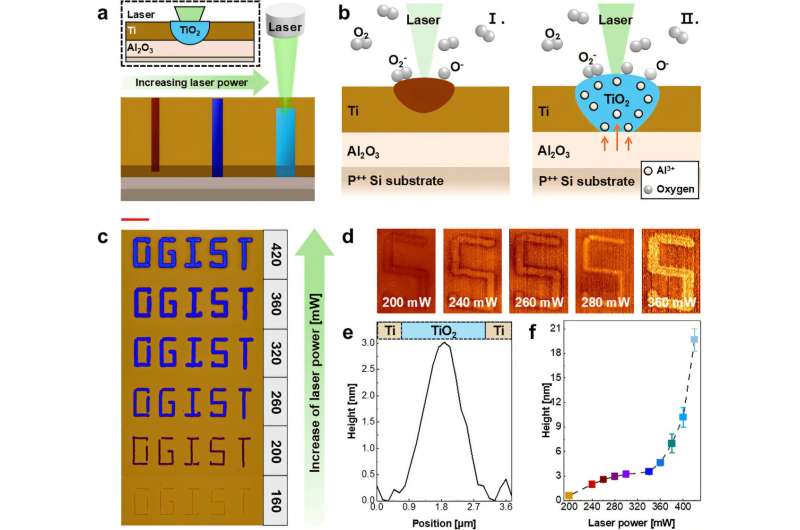
Researchers at the Daegu Gyeongbuk Institute of Science and Technology (DGIST) have developed a single-step laser process that transforms the electrical properties of semiconductors. The Laser-Induced Oxidation and Doping Integration (LODI) technique enables titanium oxide (TiO₂)—a material previously limited to electron-based conduction—to function as a hole-based p-type semiconductor.
The study demonstrates how LODI combines oxidation and doping into one laser irradiation step, offering a drastic simplification over traditional multi-phase, high-temperature semiconductor fabrication methods. The innovation, led by Professor Hyukjun Kwon and his team, could significantly reduce the time, cost, and equipment complexity involved in chip production.
Semiconductors operate as either n-type or p-type materials depending on their charge carriers—electrons or holes. Modern electronics, including CMOS circuits found in smartphones and computers, rely on the seamless integration of both types. However, certain stable materials like titanium oxide, despite their environmental and structural advantages, have remained limited to n-type operation due to restricted hole mobility.
The team’s LODI method overcomes this limitation. By layering aluminum oxide (Al₂O₃) on titanium (Ti) and exposing the stack to a laser for just a few seconds, aluminum ions diffuse while titanium oxidizes, forming TiO₂. The laser simultaneously breaks the electron balance, generating holes that convert the material into a p-type semiconductor.

Traditional approaches to achieving this conversion demand multiple steps—such as vacuum ion implantation and prolonged thermal treatment—requiring expensive equipment and hours of processing. LODI performs the same transformation almost instantaneously under normal conditions, with built-in patterning capability, paving the way for scalable, energy-efficient manufacturing.
The simplicity and precision of LODI could accelerate the development of flexible electronics, sensors, and optoelectronic devices, marking a pivotal advance in the evolution of semiconductor processing.“This study demonstrates a direct, controllable way to engineer the conductivity of oxide semiconductors through a single laser process,” said Kwon. “By converting titanium oxide from n-type to p-type efficiently, we’re setting a foundation for next-generation, highly integrated, and reliable semiconductor devices.”