




The three-color LED gives color control, fits in small spaces, and works in hot or cold places used in cars, screens, tools, and machines.
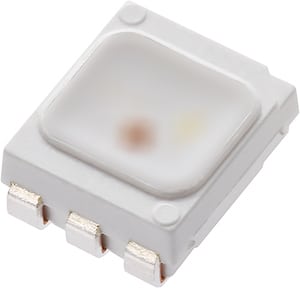
Vishay Intertechnology, Inc. has launched the Automotive Grade VLMRGB6122.. tricolor LED for interior automotive lighting, RGB displays, and backlighting. Housed in a 3.5 mm × 2.8 mm × 1.4 mm PLCC-6 surface-mount package, the LED delivers luminous intensity up to 2800 mcd at 20 mA.
The device includes separate anode and cathode connections for its red, green, and blue LED chips. This setup supports individual control of each color. It enables color mixing within the triangle area defined by the CIE 1931 color space.
The LED uses AllnGaP and InGaN chip technologies to achieve 70% higher brightness than earlier versions. It is 22% thinner than other models, making it usable in low-profile layouts.
The LED operates across a temperature range of -40 °C to +110 °C, above the standard range by 25 °C. It supports Class B1 corrosion robustness and is AEC-Q102 qualified. For electrostatic protection, it withstands up to 2 kV for red and 8 kV for green and blue, tested under JESD22-A114-B.
It is RoHS-compliant, halogen-free, and Vishay Green-marked. The LED supports IR reflow soldering and is categorized per reel by intensity, color, and forward voltage.
This setup gives advantages for developers. With chip-level control, engineers get more freedom in shaping lighting behavior across systems—from vehicles to screens. The high brightness and low-profile size allow use in tight spaces without loss of light output.
Its thermal and electrical properties support use in environments with wide temperature change and physical stress. Dashboards, indicators, and signal lights stay consistent under exposure to heat, cold, and movement.
Production teams benefit from per-reel binning and IR reflow support, which simplify assembly and ensure consistent color and brightness.
The tricolor LED fits many end uses. Automotive makers can use it for adjustable cabin lighting and signal systems. In electronics, it supports color backlighting in thinner forms.
Medical and industrial teams get a lighting option that meets safety and environmental rules. Design teams aiming to reduce part count and increase system life will find the LED useful for its brightness, size, and build.


