The rectifier modules save energy, work in high heat, and handle large currents, making power systems and battery setups more efficient and reliable.
Industrial power conversion often struggles with high conduction losses, thermal stress, and the need to handle large currents reliably. Engineers designing high-frequency converters, power supplies, and large battery systems must maintain efficiency while keeping devices compact and compatible with standard packages. Meeting these demands requires components that can operate at high temperatures, offer low forward voltage drop, and have minimal reverse recovery charge.
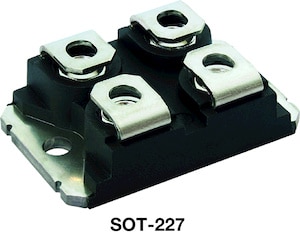
Vishay Intertechnology, Inc. addresses these challenges with four new 100 V Gen 2 Trench MOS Barrier Schottky (TMBS) rectifier modules in the compact, fully insulated SOT-227 package. The devices deliver a best-in-class forward voltage drop down to 0.83 V, reducing conduction losses and improving overall efficiency. They combine ultra-low forward voltage drop with high current ratings and negligible reverse recovery charge, while supporting operation at temperatures up to 150 °C.
The module lineup includes dual-diode versions, 100 A VS-QA100FA10, 200 A VS-QA200FA10, 400 A VS-QA400FA10 in parallel configurations, and a 150 A single-phase bridge VS-QA150BA10. Their industry-standard SOT-227 package allows drop-in replacement of competing solutions, enabling engineers to improve efficiency without redesigning existing systems.
These rectifiers are intended for high-frequency converters and power supplies in welding and industrial SMPS applications, 48 V battery-powered light vehicles, telecom equipment, and as blocking diodes for large battery systems. All four devices—VS-QA100FA10, VS-QA150BA10, VS-QA200FA10, and VS-QA400FA10—are RoHS-compliant and UL-approved under file E78996, ensuring reliability, regulatory compliance, and suitability for demanding industrial and commercial applications.