
Architecture brings native 1.2 V I/O to high-speed, low-power SoC designs, delivering faster transfers, quicker program/erase times, and sharply reduced read power an advantage for wearables, edge AI, automotive systems, and dense data-center hardware.
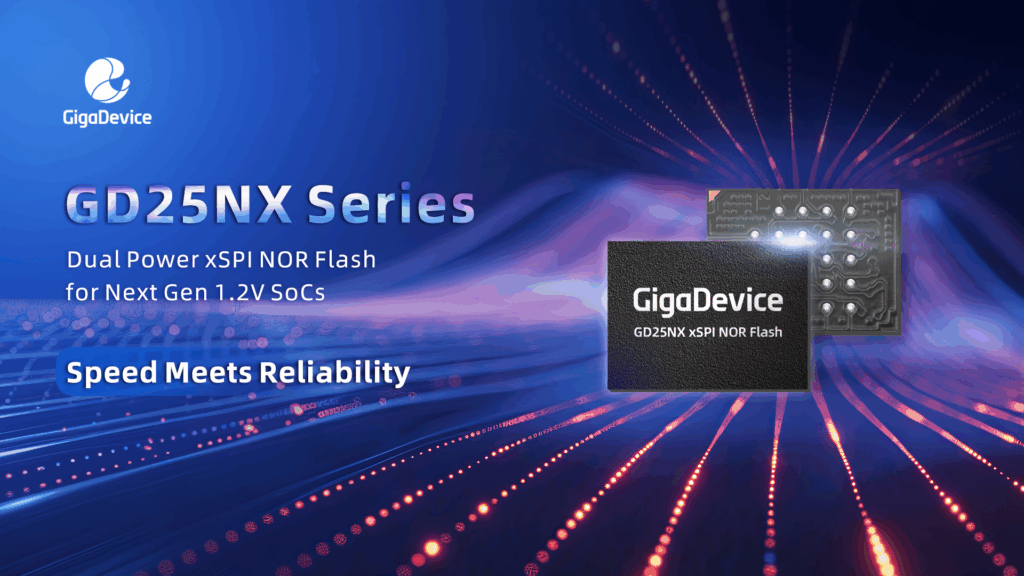
GigaDevice is pushing xSPI NOR Flash deeper into low-power territory with its new GD25NX series, a dual-voltage lineup designed to plug directly into 1.2 V SoCs. The move eliminates the need for external voltage-boosting circuits an increasingly relevant constraint in wearables, edge AI modules and compact automotive electronics, where every milliwatt and every square millimeter count. Beyond reducing BOM cost and power overhead, the parts aim to deliver full octal-SPI performance without compromises in throughput or reliability.
The key features are:
- Native 1.2 V I/O dual-voltage design
- 200 MHz octal xSPI, 400 MB/s throughput
- 0.12 ms program, 27 ms erase
- Built-in ECC/CRC + DQS
- Up to 50% lower read power consumption
The latest xSPI NOR Flash generation focuses on delivering higher performance and stronger efficiency for next-generation low-voltage SoCs. Read, program, and erase operations are noticeably faster than previous octal designs, giving systems quicker access to code and data without adding power or board complexity. The device also brings reliability features typically reserved for more advanced memory classes. Integrated ECC and CRC protect data across long product lifecycles, while DQS support helps maintain clean, stable signaling in high-speed layouts an increasingly important requirement as SoCs pack more functionality into tighter spaces, especially in data-center hardware and automotive electronics.
Power efficiency is another major gain. The new architecture cuts read consumption substantially compared with standard 1.8-volt octal Flash, making it especially useful for devices that shift between high-speed bursts and low-power idle modes. Wearables, edge AI nodes, and compact embedded systems stand to benefit the most, where lowering active power directly improves thermals, battery life, and form-factor flexibility.
The series arrives in moderate densities suited for code storage and fast-read applications, offered in compact BGA and WLCSP packages designed for tight board layouts. More capacities and package options are already planned, expanding the family’s reach across broader embedded and low-voltage design segments.