




Wearables read sweat chemistry, but the numbers lie when the body moves. A new transistor trick strips out that drift and reveals the real signal.
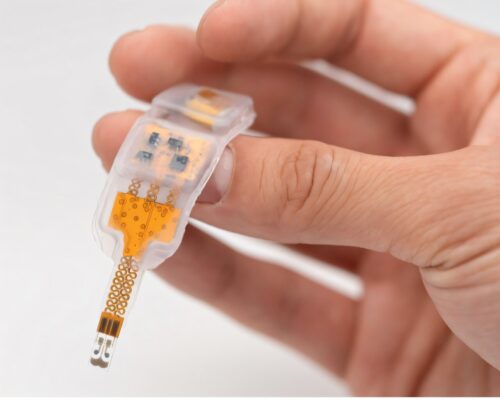
Wearable devices are used to track fitness, glucose, stress and signals linked to disease, but the biosensor signals they collect are often not correct. Bending, moisture, stretching and changes in temperature add errors and cause drift that is not part of the signal. This limits the use of wearable biosensing for health tracking and medical decisions because users and doctors cannot trust the numbers.
To address this problem, a team at Stanford University built skin-like biosensors using organic field-effect transistors (OFETs) that can monitor chemical biomarkers in sweat with stability when the environment changes. The devices interface with the body. Most soft biosensors suffer from drift and noise due to motion, heat and moisture, so the goal was to make a soft OFET-based biosensor that is drift-free and can be tuned to detect many types of signals.
The design uses a twin layout: two OFETs with matching stacks and dimensions placed close to each other. Because both transistors drift and react to external noise in the same way, their signals can be subtracted through a diode link. Shared drift is removed, leaving the signal from the target through separate gates for target and reference receptors. This subtraction removes distortion before the data is read.
Tests showed that the sensor cut errors from motion, heat and moisture and could track chemicals in sweat such as cortisol, glucose and sodium. It suppressed distortion from bias-stress, strain, compression and temperature variation by more than two orders of magnitude. It also enabled on-body cortisol sensing, which can be linked to stress and early signs of mental conditions. The biosensor was integrated with a circuit and a phone app to show use in real-world health tracking, including stress monitoring.
Future work may add signal-conditioning circuits on the same platform to raise sensitivity and signal quality. There is interest in full soft electronic skins that combine sensors, conditioning, power and wireless links in one platform for continuous drift-free health monitoring on the body.
