Measuring Quantum noise has been challenge. What could theoretically take 20 million years to measure now only takes minutes.
Every physical system produces noise and in quantum devices these noise grow very hard to measure, as the number of tests rises exponentially. If scientists do not know the exact noise data, it is difficult to design reliable quantum hardware.
That’s where Entangled Light comes into play. It reduces the number of tests or measurements needed to identify the noise in a quantum system. Entangled light is created by linking the photon pair’s energy state, time in a quantum state.
The method uses two beams of entangled light. One beam interacts with a noisy system while the other serves as a reference. Comparing the two cancels shared noise and extracts more information from each measurement. As classical beams cannot do this, as they lack quantum correlations.
The outcome shows why entanglement changes the measurement problem. Classical approaches require an exponential number of trials as system in size, making complex devices impossible to characteristic in practice.
Using entanglement, the time drops from a scale equal to 20 million years to around 15 minutes. This matters because it proves that quantum resources create efficiency gains unattainable with classical methods.
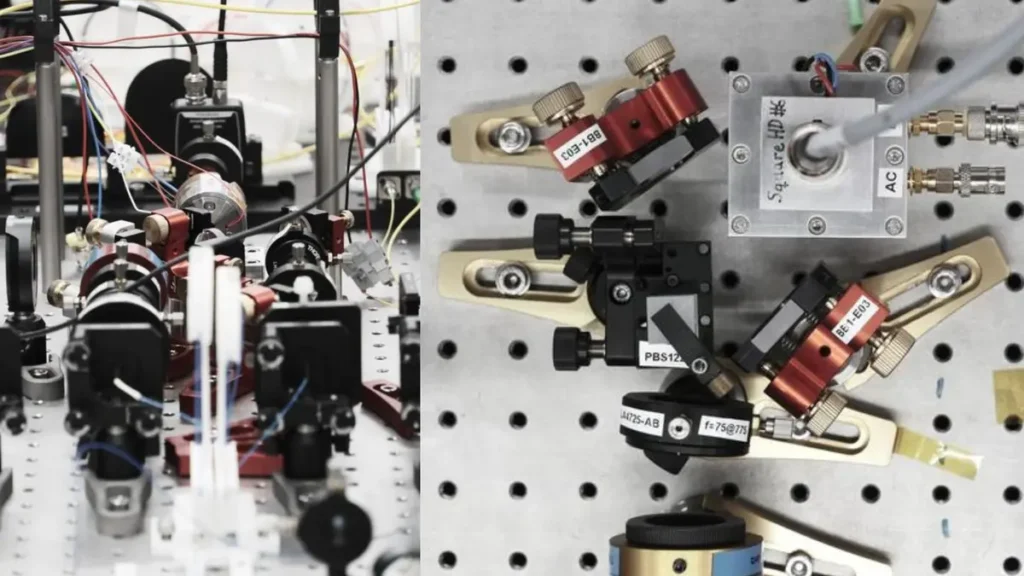
The researchers at Technical University of Denmark have built the experiment using standard optical components operating at telecom wavelengths. Losses in the setup do not prevent the effect. This matters because it shows the result is not dependent on ideal equipment, making it relevant for real-world systems.
The demonstration has wider implications for industries that rely on accurate noise characterisation. Quantum sensing, secure communications and machine learning all need precise information about system behaviour. Faster measurement reduces costs, improves design cycles and supports scaling to larger devices.