

Osaka researchers unlock spin-selective charge flow in organic solar cells, using mirror-image molecular designs that sharply cut recombination and boost efficiency threefold.
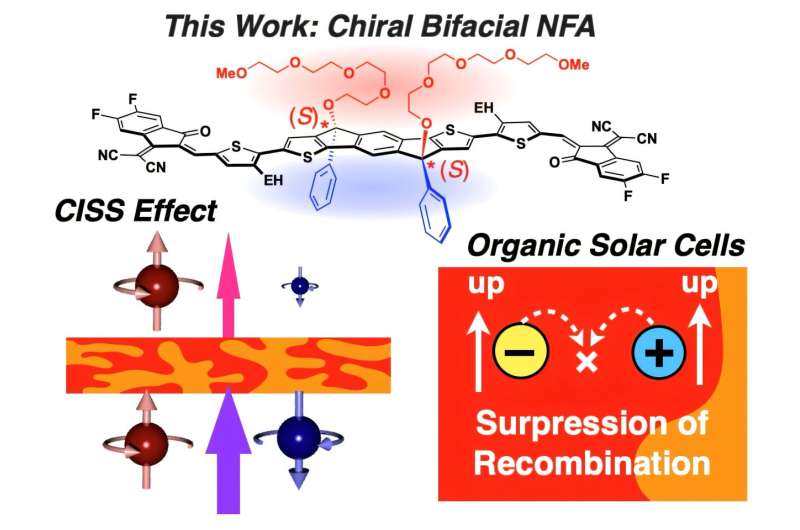
A new materials strategy using mirror-image, or chiral, molecules has delivered a threefold jump in organic solar-cell performance, marking a potential turning point for low-cost, flexible photovoltaics. Researchers at the University of Osaka report that specially engineered “bifacial” acceptor molecules can generate spin-polarized currents that sharply reduce charge recombination—the core efficiency roadblock in organic solar technology.
Organic photovoltaics (OPVs) are attractive for lightweight and flexible applications, but they lag far behind silicon because electrons and their corresponding “holes” tend to recombine before contributing to current. The Osaka team’s approach targets this bottleneck at the molecular level by redesigning the symmetry of electron-acceptor materials.
The work shows that vertically asymmetric, chiral acceptors alter how electrons travel through the material. Unlike conventional designs that focus on left–right asymmetry, these new molecules introduce top–bottom differences that create two non-superimposable, mirror-image forms. This chirality changes how charges separate and move.
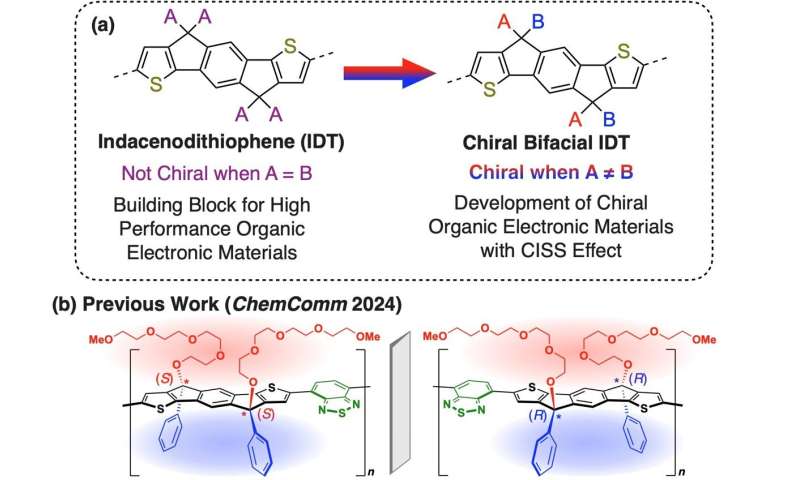
A key outcome is chirality-induced spin selectivity (CISS)—a phenomenon where each mirror-image molecule prefers electrons of a particular spin orientation. That spin filtering leads to a spin-polarized current, and this polarization helps keep electrons and holes apart for longer, suppressing recombination.
The researchers also found that the chiral acceptors pack more efficiently and mix better with donor polymers, smoothing electron transport pathways across the active layer. Combined, these effects pushed device efficiency to around 8%, roughly three times higher than cells built with non-chiral analogues.
For OPVs—where every incremental gain is hard won—demonstrating performance jumps through molecular symmetry control opens a new route for device engineering. The study signals a shift from merely tweaking polymer backbones or fullerene replacements to leveraging spin physics inside soft materials.If these chiral, spin-selective acceptors scale, they could accelerate organic solar cells toward mainstream use in lightweight panels, building-integrated photovoltaics, and portable power systems, potentially delivering cheaper and greener solar generation technologies.