ISROs Air Drop Trial (IADT- 01) addressed a critical need: qualifying the parachute-based deceleration system, which is mandatory before human spaceflight clearance is granted.
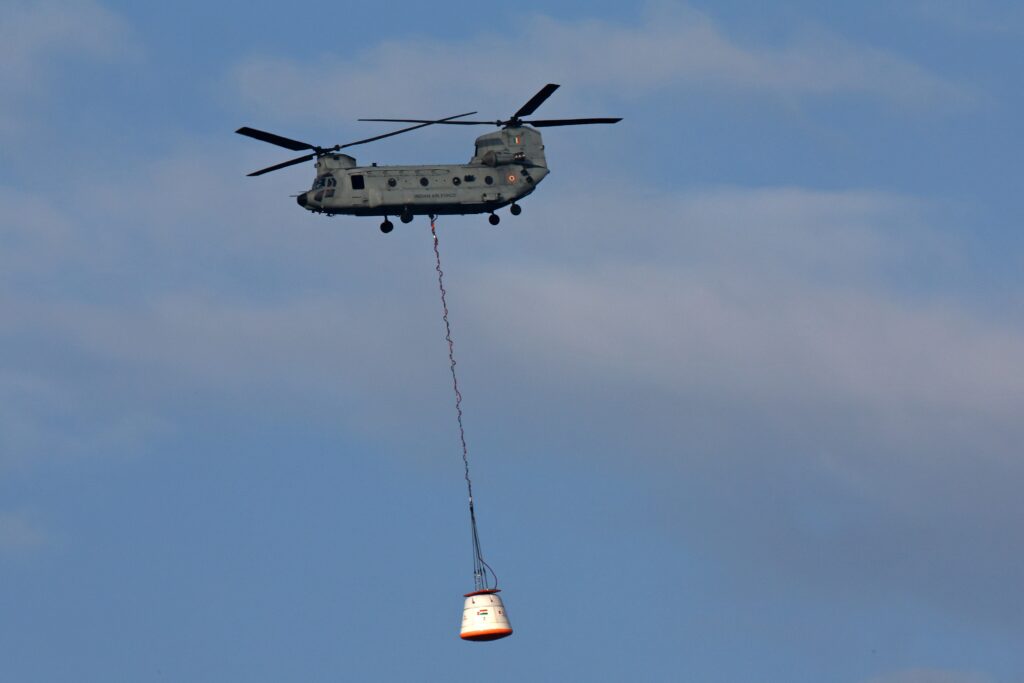
The Indian Space Research Organisation (ISRO) has completed the first Integrated Air Drop Test (IADT-01) of the Gaganyaan crew module at the Satish Dhawan Space Centre, in Sriharikota. The exercise demonstrated the end-to-end performance of the parachute-based deceleration system designed to bring astronauts safely back to Earth.
A simulated crew module weighing 4.8 tonnes was released from an altitude of about 3 km using an Indian Air Force Chinook helicopter. The system was triggered by onboard avionics, and ten parachutes were deployed in sequence. The sequence began with Apex Cover Separation parachutes, followed by Drogue, Pilot and Main parachutes. Each stage progressively slowed the module before the three main parachutes reduced terminal velocity to around 8 m/s.
The test simulated a possible launch-pad abort scenario. Avionics, the electronics system in the aircraft, collected and transmitted performance data, which was also stored on a Solid State Data Recorder. After splashdown, the module was recovered by the Indian Navy and transported on INS Anvesha to Chennai port.
System developers also tested mortar-based ejection devices, pyro-releasers and solid-state recording units. These subsystems were qualified individually before integration. The terminal velocity was reduced to about 8 m/s, aligning with design thresholds set by ISRO’s human spaceflight safety standards.
Preparation for the test involved modelling of crew module dynamics, multiple sorties with dummy hardware, and validation of procedures with the Indian Air Force. The Test Authorisation Board cleared the mission following these rehearsals.
ISRO’s parachute design group worked with DRDO on material engineering, while avionics engineers configured the onboard control logic. The Indian Navy and Coast Guard supported recovery engineering, including sea-handling and transport of the capsule.
IADT-01 forms part of system-level qualification for Gaganyaan. Engineers plan further air-drop trials under varied conditions to strengthen data for final certification. These steps are prerequisites before the first uncrewed orbital mission scheduled for late 2025.