A very thin Graphene layer, when twisted at a proper angle, forms a new material called Intercrystal, showing signs of electronic behaviour.
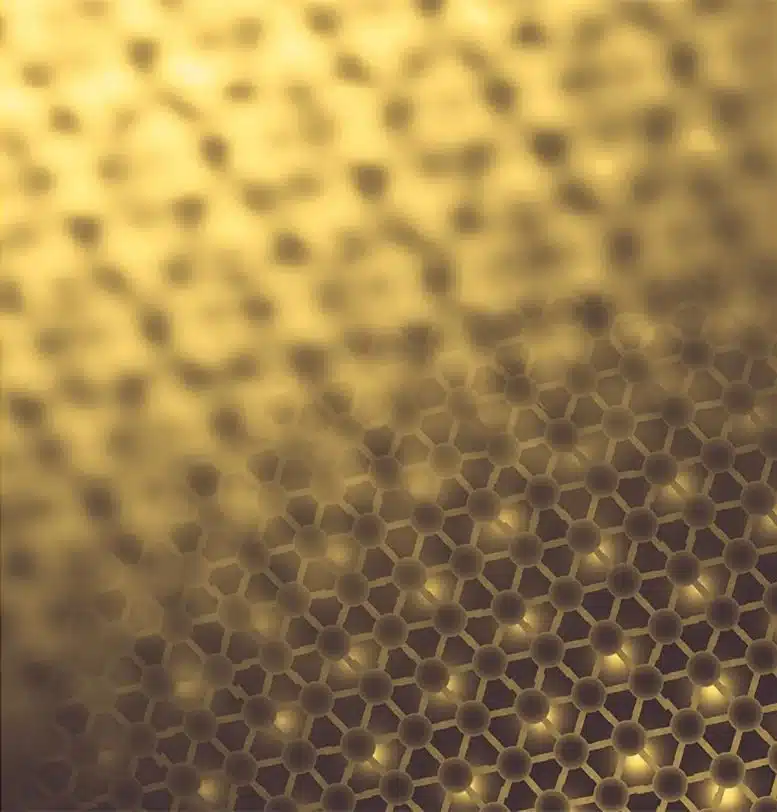
Researchers at Rutgers University have identified a new class of materials, termed intercrystals, which demonstrate electronic behaviours not previously observed in conventional crystals or quasicrystals. The discovery, published in Nature Materials, could influence the development of future quantum systems, electronic circuits, and sustainable materials.
The material was engineered by stacking two atom-thin graphene layers on top of a hexagonal boron nitride crystal. When the graphene sheets were twisted at a slight angle, moiré interference patterns emerged. These patterns altered the motion of electrons in the material without changing its chemical composition.
The resulting electronic structure differs from traditional crystals, where atomic arrangements are periodic and symmetric, allowing electron motion to be predicted. In contrast, intercrystals maintain some symmetry but lack translational order. This hybrid behaviour allows for tunable electronic functions through geometry alone.
The approach builds on a field known as twistronics, where electron properties in layered materials are controlled by adjusting twist angles. Earlier work by the same team demonstrated how moiré patterns could modify graphene’s electronic structure. This new finding extends the concept into a new material phase.
The variability in electron flow within intercrystals could support phenomena like superconductivity and magnetism, previously inaccessible through standard crystal structures. Such control opens use cases in low-resistance circuits, atomic-level sensors, and quantum computing components.
In addition to functional benefits, the materials are composed of abundant and non-toxic elements—carbon, boron, and nitrogen—suggesting a path toward environmentally friendly electronics that do not rely on rare earths or heavy metals.