




A new nine-wavelength chip-on-board technology packs multiple emitters into one compact package, supporting medical diagnostics, wearables, and chemical analysis with flexible configurations for next-generation sensing.
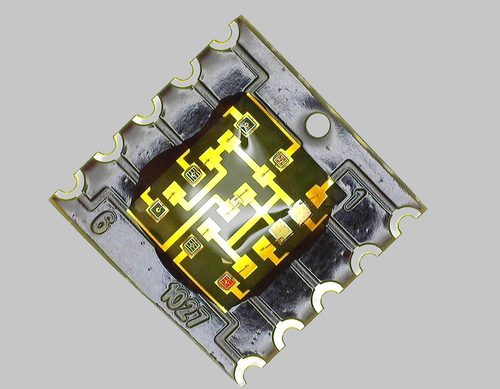
Marktech Optoelectronics has expanded its multi-wavelength optoelectronic portfolio with a new nine-wavelength chip-on-board (COB) technology, providing multiple independently addressable wavelengths in a compact package for advanced sensing applications. The technology is designed for systems used in medical diagnostics, wearables and chemical analysis.
The new COB approach enables up to nine wavelengths to be integrated into a single surface-mount package. Customers can select standard or customised wavelength combinations, allowing the emitter configuration to be adapted to different optical sensing requirements.
Marktech says the compact design can also incorporate silicon, silicon carbide (SiC) and indium gallium arsenide (InGaAs) photodiodes. This enables both light emission and detection functions to be combined within a single assembly, potentially reducing the space and interconnection requirements of multi-component optical systems.
For demanding applications, the company is also offering co-packaged multi-wavelength emitters with InGaAs detectors. Its recently introduced devices combine multiple visible and near-infrared LED chips with an InGaAs photodiode, providing a broad response range in one compact package.
The nine-wavelength capability gives designers greater flexibility when developing optical sensing equipment. Different wavelengths can be selected to interact with or measure specific materials, making the approach suitable for applications where several optical channels are required within a limited footprint.
Potential uses include medical diagnostic equipment, wearable sensing devices and chemical analysis instruments. The integrated package could help simplify optical architectures while supporting customised sensing configurations.
Marktech is positioning the technology as part of its wider multiple-chip, multiple-wavelength product range. By combining several emitters and optional detectors within compact assemblies, the company aims to support next-generation optical sensing systems that require greater wavelength flexibility without significantly increasing system size.
