




By eliminating rigid motors and gears, the system relies on material behaviour to perform multiple coordinated actions.
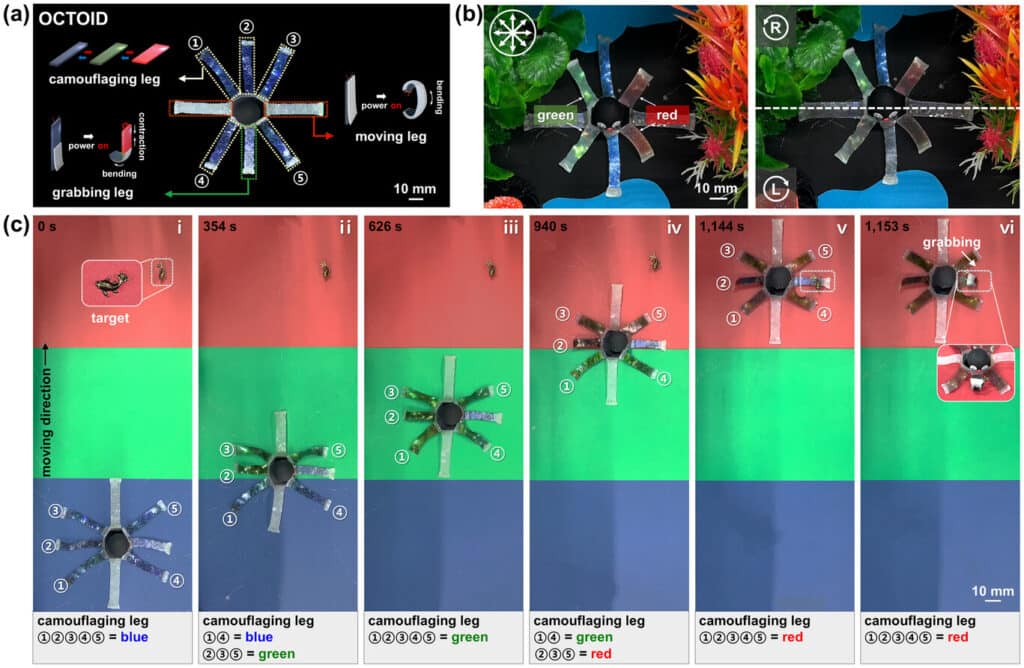
Researchers in South Korea develops a robot that can crawl, change colour and grab objects, all at the same time. It is made from a material that responds to heat, known as cholesteric liquid crystal elastomer (CLCE).
These flexible plastics contain molecules similar to those in LCDs, causing them to change colour and size with temperature. This means the same material can both crawl and change colour without the need for motors.
The robot, called OCTOID, uses these materials to mimic how an octopus moves and camouflages in its surroundings. The robot consists of two layers: the active and passive layers.
The active layer is made up of CLCE, which reacts to heat by contracting and changing colour.

The passive layer is a stronger, transparent material that supports the robot’s movement and controls how much it bends.
To power these movements, thin nichrome wire is used, which converts electricity into heat, just like an electric kettle or geyser. These wires are embedded inside the robot’s legs. When electricity flows through them, the wires heat up. This heat triggers the CLCE molecules to contract, causing the robot’s legs to bend or curl.
At the same time, the material changes colour from blue to red with increasing temperature. By adjusting the electric current, the robot’s movement and colour can be precisely controlled.
Tests show that OCTOID’s legs can shrink by nearly 30 per cent under 4 watts of power and move forward at about 0.45 millimetres per second. Each leg can lift objects up to 30 times its own weight and repeat these actions more than 100 times without wearing out. The colour change helps it blend into its surroundings.


