




Imagine a wallpaper thin light that works like the sun, gives light, and is easy on your eyes. New LEDs could change screens, rooms, and sleep.
Thin indoor lighting that appears natural and reduces sleep disruption is rare, even though people want lights that create a comfortable, sun-like atmosphere. Existing thin LEDs often fail to match sunlight across all colors, especially yellow and green, limiting their usefulness for eye-friendly displays, adaptive indoor lighting, and specialized applications such as horticulture and well-being.
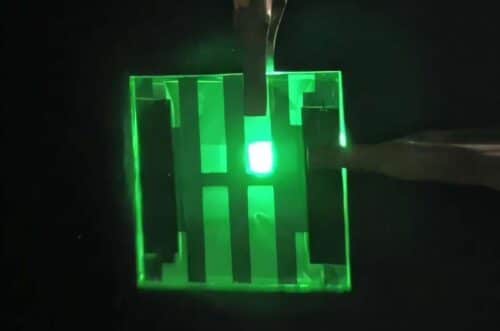
Researchers from American Chemical Society have developed paper-thin quantum dot LEDs (QLEDs) that emit a warm, sun-like glow. The study demonstrates the feasibility of ultra-thin, large-area QLEDs that closely match the solar spectrum. These devices could support next-generation displays, adaptive indoor lighting, and wavelength-tunable light sources.
Previous approaches used flexible LEDs with red and yellow phosphorescent dyes to mimic a candle-like glow. Quantum dots, which convert electrical energy into colored light, offer a promising alternative. The research team synthesized red, yellow-green, and blue quantum dots coated with zinc-sulfur shells and identified the color ratios that produced an emission spectrum closest to sunlight.
A QLED was fabricated on an indium tin oxide glass substrate, layering electrically conductive polymers, the quantum dot mixture, metal oxide particles, and finally a layer of aluminum or silver. The quantum-dot layer measured only tens of nanometers in thickness, much thinner than conventional color conversion layers, resulting in a white QLED comparable in thickness to wallpaper.
Initial tests showed the thin QLED performed best under an 11.5-volt power supply, emitting bright, warm white light with higher red and lower blue intensity, beneficial for sleep and eye health. Objects illuminated by the QLED appeared close to their true colors, with a color rendering index above 92%.
Further experiments produced 26 white QLED devices using the same quantum dots but varying electrically conductive materials to optimize operating voltage. These devices reached maximum light output at just 8 volts, and approximately 80% exceeded brightness targets for computer monitors.


