Researchers develop an all-optical artificial synapse that processes and stores information using light, improving neuromorphic vision performance while reducing energy use in next-generation AI hardware.
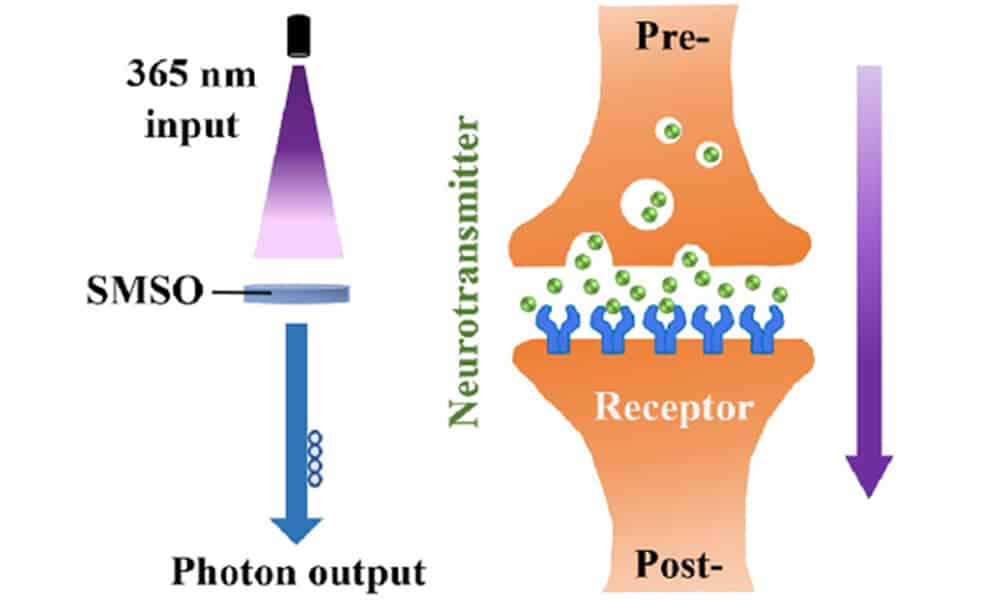
A research team has developed a photon-driven artificial synapse that could help reduce power consumption in future neuromorphic computing systems by replacing electrical signal processing with light-based operations.
The device, reported in Advanced Photonics, uses a rare-earth-doped crystal capable of storing and processing optical information without converting signals into electricity. The approach addresses a long-standing challenge in artificial intelligence hardware, where constant data transfers between processors and memory increase energy consumption and limit performance.
Unlike conventional neuromorphic devices that rely partly on electrical controls, the new synapse operates entirely through optical signals. The crystal generates both immediate and delayed light emissions after illumination, allowing it to mimic the adaptive behavior of biological synapses. Information is stored through trapped charge carriers whose response changes depending on previous light exposure, creating a memory effect similar to neural learning.
Researchers demonstrated two key synaptic behaviors. Under ultraviolet illumination, the device strengthened its response to successive light pulses, reproducing paired-pulse facilitation. Near-infrared stimulation produced the opposite effect, weakening subsequent responses and creating paired-pulse depression. Together, these mechanisms allow the system to emulate both excitatory and inhibitory neural functions.

To validate the concept, the team integrated the optical synapse with a silicon image sensor, creating a prototype neuromorphic vision platform. The setup performs image enhancement directly during capture, preserving stronger visual signals while suppressing background noise. This in-sensor processing reduces the need for additional computing steps and lowers overall system complexity.
Testing showed significant gains in image recognition accuracy. A neural network model based on the device achieved 95.99% accuracy in handwritten digit classification after optical denoising, compared with roughly 78% when noise reduction was not applied.
Although the current device operates on millisecond-to-second timescales, researchers believe performance can be improved through material engineering and miniaturization. The work highlights the growing potential of photonic hardware that combines sensing, memory and computation within a single platform, opening opportunities for low-power AI systems in robotics, edge computing and intelligent imaging applications.