




Can one transformer make power systems smaller, lighter, and stronger for space and defense use? Engineers may want to see this new design.
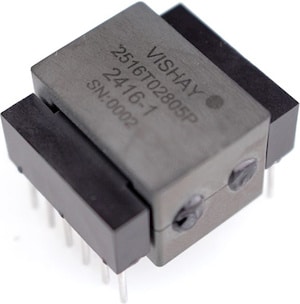
When we design power systems for avionics, military, or space use, size, weight, and reliability are constant trade-offs. Traditional transformers for 28 V forward converters take up space, add cost, and may not meet mission needs. That is where Vishay’s new planar transformers come in.
The SGTPL-28 series from Vishay is built to simplify our work. These are 150 W low profile, space grade planar transformers, the first ones made for 28 V input forward converters in AMS applications. They are smaller, denser, and lower in cost than standard options, while meeting MIL PRF 27 level T, INST EEE 002, and MIL STD 981 standards.
We can use them in 28 V forward converters, switch mode power supplies, and active clamp or dual switch forward converters. Each unit has multiple secondary windings with a center tap, which can power two 12 V channels or four 5 V channels. They operate up to +130 °C and can handle vibration and thermal shock in tough environments.
The design allows up to 40% more winding fill than standard planar transformers. This gives higher power density and smaller size. The construction also makes customization easier for specific needs. Vishay’s material choices and production flow lower cost, and its inventory setup helps keep lead times short without NRE costs for custom versions.
There are six screening options: P level for design validation, L level for LEO missions, INST EEE 002 level 2 and 3, MIL STD 981 Table VI class B, and MIL STD 981 Table VI VII class S.
They support 18 V to 36 V input, 1250 VDC dielectric withstand, and 0.5 µH leakage inductance. Samples and production units are available now, with lead times from eight to 26 weeks depending on the screening level.
It is a simple upgrade for those designing power systems in harsh environments.

