




Organic electronics and electrolyte mimic photoreceptor response for next-gen artificial vision systems.
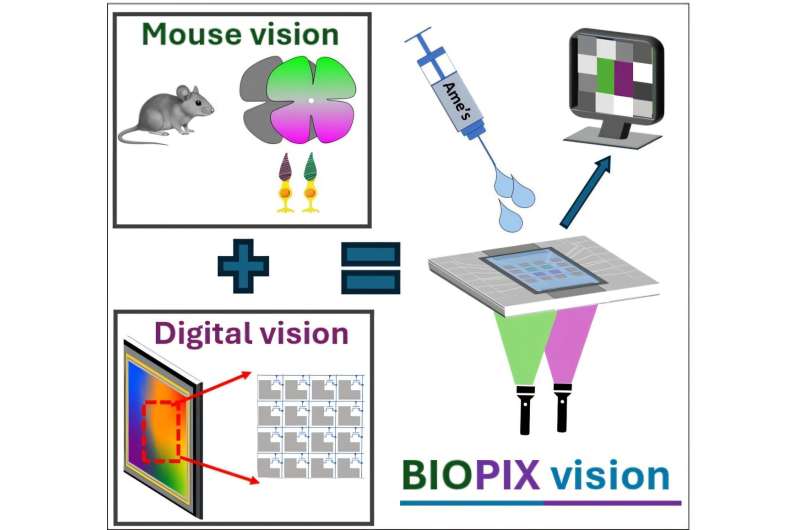
Researchers at Tor Vergata University of Rome have developed a biohybrid image sensor that mimics how the animal retina detects light, potentially advancing artificial vision technologies and neuromorphic electronics.
The device, called BIOPIX, integrates organic electronics with a water-based biological electrolyte to emulate the behaviour of retinal photoreceptors. Developed by a multidisciplinary research team, the sensor converts incoming light into electrical signals in a way that resembles how rod and cone cells process visual information in biological eyes.
Unlike conventional CMOS image sensors that rely purely on semiconductor photodiodes, BIOPIX blends solid-state electronics with a liquid biological environment. The prototype includes a 16-pixel array built from printed organic semiconductors, transparent microelectrodes, and platinum reference electrodes immersed in an electrolyte commonly used in retinal research.
Within the array, twelve pixels are tuned to replicate rod-like responses for light intensity detection, while a central 2×2 group mimics cone-like photoreceptors that detect colour. When light strikes the sensor, each pixel generates an electrical signal via the electrolyte interface, enabling the system to reconstruct images in real time.
The design aims to replicate both the spectral and temporal response characteristics of the retina. According to researchers, the goal is not only to produce images but also to better understand how biological photoreceptors convert light into neural signals.
Scientists say the platform could support future work on retinal prosthetics and artificial photoreceptors. Degenerative eye diseases such as retinitis pigmentosa and age-related macular degeneration cause the loss of photoreceptor cells, leading to progressive vision impairment. A bio-inspired sensor architecture may help develop technologies that restore or augment visual perception.
Beyond medical applications, the technology could influence next-generation machine vision systems. By combining biological interfaces with electronic circuits, such sensors may enable more efficient visual processing for robotics, adaptive imaging, and neuromorphic computing.
Researchers describe BIOPIX as an early proof of concept that demonstrates how electronics and biological materials can be integrated to replicate complex sensory functions. Future versions may scale to higher pixel densities and more advanced signal processing architectures, bringing artificial vision closer to the efficiency and adaptability of natural eyesight.

