

Researchers at JNCASR and IISc report a Seebeck coefficient exceeding 124 millivolts per Kelvin in scandium nitride films, surpassing a long-accepted thermopower limit for crystalline semiconductors.
Researchers at the Jawaharlal Nehru Centre for Advanced Scientific Research (JNCASR) in Bengaluru, working with collaborators including the Indian Institute of Science (IISc) and the University of Sydney, have reported an unusually large thermoelectric response in scandium nitride (ScN) thin films. The work shows a Seebeck coefficient exceeding minus 124 millivolts per Kelvin near room temperature, surpassing the range traditionally expected for crystalline semiconductors.
The Seebeck effect converts a temperature gradient into an electrical voltage. The strength of this response is measured by the Seebeck coefficient, expressed in volts per Kelvin. Conventional transport theories generally constrain thermopower in crystalline materials to only a few millivolts per Kelvin, a limit often described as the Boltzmann thermopower limit. The team reports scandium nitride films that exceed this conventional bound.
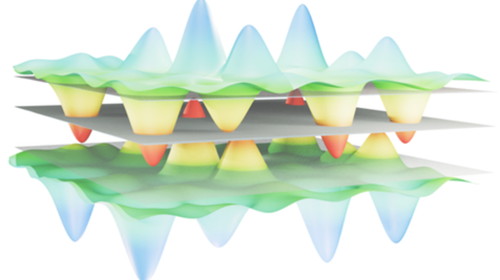
The films are heavily doped, highly compensated (HDHC) epitaxial scandium nitride (ScN). In this material, large numbers of donors and acceptors are present, causing their charge contributions to substantially compensate each other. The randomly distributed charged dopants create potential fluctuations that distort the material’s electronic energy landscape. Charge carriers then move through this landscape by percolative transport rather than uniformly through the crystal. According to the researchers, this transport regime is responsible for the unusually large thermopower, with ultrathin films showing a further enhancement as thickness is reduced. The team describes the result as a solid-state analogue of electrolyte-like thermopower in a crystalline semiconductor.
The reported Seebeck coefficient exceeds minus 124 millivolts per Kelvin near room temperature, an exceptionally large thermoelectric response for a crystalline semiconductor. Bismuth telluride and its alloys, widely used in near-room-temperature thermoelectric modules, typically have Seebeck coefficients in the range of a few hundred microvolts per Kelvin, with reported values commonly around 160 to 230 microvolts per Kelvin depending on composition and carrier type.
The response is therefore hundreds of times larger in magnitude than the thermopower of conventional bismuth telluride materials. That makes the result particularly interesting for applications involving the detection of very small temperature differences. However, a large Seebeck coefficient alone does not guarantee efficient power generation. Thermoelectric performance also depends on electrical conductivity and thermal conductivity through the material’s overall figure of merit. The reported work therefore represents an unusual thermopower result rather than a demonstrated conversion-efficiency record.
This remains a laboratory-stage result rather than a commercial technology. The team has also demonstrated an early photon-sensor prototype based on the material, where local laser illumination produced a measurable thermoelectric response. However, there is no indication yet of pilot-scale manufacturing or a commercial device product.
The work originates from Indian research institutions, with JNCASR leading the research alongside IISc collaborators. Its unusually large thermopower may be particularly relevant to sensitive temperature sensing and instrumentation rather than conventional thermoelectric power generation. Scandium supply could present a challenge for large-scale manufacturing, but the more immediate opportunity lies in sensors and instrumentation based on this physics.
For more information, click here.