





KIT researchers have built a solid-state cooling unit that uses waste heat instead of electricity, using two thin shape-memory alloy films.
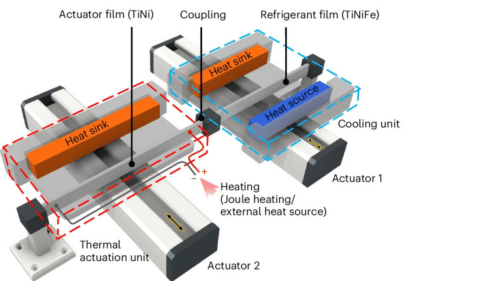
A research team at the Karlsruhe Institute of Technology (KIT) has demonstrated a cooling device driven entirely by heat. The work comes from the Institute of Microstructure Technology, where Dr Jingyuan Xu leads the ZEco Thermal Lab. The device uses two thin films of shape-memory alloy, with one acting as a thermal actuator and the second as the refrigerant. According to Dr Xu, the combination is the key innovation: “The crucial innovation is that we combine two complementary functions of shape memory alloys, with one film converting heat into mechanical work and the other film converting this work into cold.”
The actuator is a 22-µm film of one-way shape-memory titanium-nickel alloy, with a composition of Ti50.18Ni49.82. When heated, the film contracts and generates a pulling force. That force is transferred to a second 26.5-µm superelastic Ti49.1Ni50.5Fe0.4 alloy film. Straining and releasing the superelastic alloy produces the elastocaloric effect, in which a change in the crystal structure causes the material to absorb latent heat and cool its surroundings. Heat is transferred through solid-to-solid contact rather than a circulating gas, and the cooling cycle does not require a conventional circulating refrigerant.
At the material level, the refrigerant film achieved a temperature span of 12.9 K. At the device level, the team measured a 4.0 K temperature span when the actuator was driven by Joule heating, falling to 2.2 K when it was driven by an external heat source. The specific cooling power reached 4.43 W/g with Joule heating and 3.32 W/g with external heating, while the cooling power at zero temperature lift was 2.79 mW. The cooling unit achieved a coefficient of performance of 2.61. The actuator reached 86°C under Joule heating and 130°C when driven by the external heat source. The actuator is also unusually stiff for its size, with the researchers reporting a force-to-displacement ratio of 14.5 N/mm, compared with about 1.1 N/mm for a commercial electromechanical actuator of comparable scale.
Vapour compression is the dominant cooling technology, from domestic air conditioners to supermarket refrigeration systems. It relies on motors, compressors and refrigerants and accounts for a substantial share of the energy used for cooling worldwide. The efficiency comparison is more useful for engineers. The authors state that elastocaloric cooling has a theoretical efficiency limit of about 84 per cent of the Carnot limit, while thermoelectric cooling operates at only 10–15 per cent of the theoretical reversed-Carnot limit. That efficiency potential is one reason elastocaloric cooling continues to attract research interest despite the mechanical complexity of repeatedly loading and unloading the refrigerant material.
This is a laboratory proof of concept, not a commercial product. The device is a miniature thin-film demonstrator, so its absolute cooling power is limited by the small active mass of the refrigerant film. The researchers note that total cooling capacity could be increased by operating multiple films in parallel. The device also operates at sub-adiabatic strain rates because of thermal constraints, while the externally heated version produces a temperature span 1.8 K lower than the Joule-heated configuration. Yi-Ting Hsiau, the lead author, described the significance of the demonstration: “The decisive moment for us was when we were able to measure the cold that had indeed been generated by a heat-driven system.”
Dr Xu said the group now intends to scale the technology, adding: “By scaling up this technology we want to develop compact cooling systems that leverage abundantly available heat sources for sustainable cooling.” KIT identifies two near-term applications: cooling computer processors using their own waste heat and cooling sensitive vehicle electronics using heat generated by the drivetrain.
Room air conditioning is expected to become an increasingly important electricity load in India. The India Cooling Action Plan (ICAP) projects overall cooling demand to grow by about eight times by 2037–38 compared with the 2017–18 baseline, while cooling demand in buildings is projected to grow by nearly 11 times. India ratified the Kigali Amendment in 2021, with its HFC phase-down compliance schedule beginning in 2028. A cooling technology that does not rely on conventional fluorinated refrigerants could therefore be relevant to India’s longer-term transition. The KIT approach also targets waste heat rather than grid electricity as its driving energy source. IIT Bombay has separately developed a patented solid-state elastocaloric cooling system based on nickel-titanium shape-memory alloys, showing that the underlying technology is also being investigated in India. For Indian manufacturers, the practical question is whether heat-driven cooling systems can eventually be scaled using alloy films that can be reliably manufactured and sourced locally. India will add cooling capacity for decades, so a technology that can use otherwise wasted heat while avoiding conventional refrigerants is worth watching, even though the KIT system remains at the laboratory-demonstration stage.
For more information, click here.

