Photonic chip can now divide a single laser beam into multiple precise colours, allowing several data streams to travel through one optical fibre.
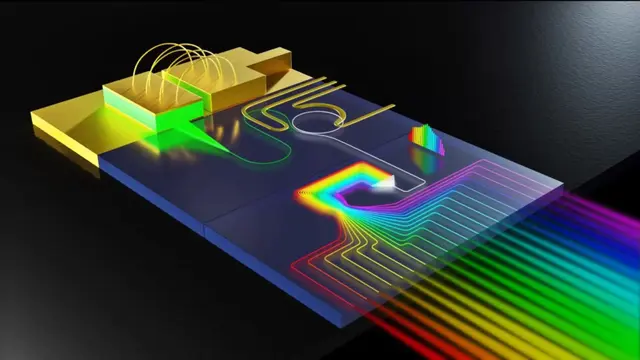
As the demand for data centres grows, the current fibre optics still relies on a single wavelength of light. As computing workloads, AI, and cloud infrastructures increase, the single channel limits how quickly data moves between servers.
Researchers have built a small chip that can turn a single beam of laser light into many separate channels. The device works by splitting one intense laser into several precise colours, a process called “frequency comb”. Each colour can move its own stream of data through a fibre-optic cable.
The team from Michal Lipson’s lab used diode, a high-power multimode laser diode, similar to those found in industrial and medical tools. These diodes produce large amounts of light but are difficult to control. The researchers found a way to steady the light by adding a locking mechanism inside a silicon chip. This process cleans up the beam and forces it into a stable, organised pattern.
Once stabilised, the light naturally divides into a set of evenly spaced frequencies. The result is a compact chip that can act like dozens of lasers working together. Such an approach could cut power use, reduce equipment space, and increase data speeds inside large data centres.
The development also points to broader use of silicon photonics technology that brings optical functions onto semiconductor chips. As data traffic continues to climb, this kind of light-based system could help future networks move information faster while keeping hardware smaller and more efficient.