A new adaptive gate-drive architecture is redefining 12–48 V motor control, delivering cooler operation, lower EMI, and smoother integration for next-gen industrial and consumer systems.
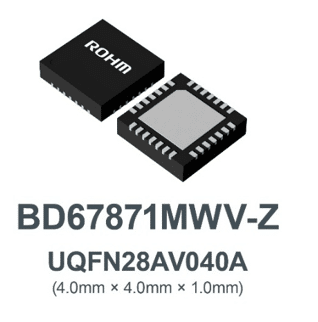
A new three-phase BLDC motor gate driver is pushing the boundaries of efficiency in mid-voltage systems, promising cooler operation, lower EMI, and easier design-in for industrial and consumer gear. The BD67871MWV-Z, powered by ROHM’s proprietary adaptive gate-drive method known as TriC3, is engineered for applications running between 12 and 48 volts—a range increasingly central to robotics, power tools, smart appliances, and compact mobility.
At the heart of the device is a persistent problem in motor electronics: switching FETs fast improves efficiency but risks excessive ringing and EMI, while slowing them down suppresses noise but wastes energy as heat. The driver attempts to eliminate that trade-off. Instead of fixed-current gate drive, its TriC3 architecture dynamically senses instantaneous FET voltage and adjusts drive current on the fly. The result, according to internal testing, is roughly 35% lower FET heat generation while maintaining comparable EMI to slower, constant-current gate-drive approaches.
The key features are:
- Adaptive TriC3 real-time gate drive cuts switching loss while suppressing ringing and EMI.
- Up to ~35% lower FET heat generation compared to constant-current gate drivers.
- Supports 12–48 V three-phase BLDC systems for industrial and consumer applications.
- UQFN28 pin-compatible package simplifies drop-in upgrades and redesigns.
- Integrated voltage-sensing feedback loop optimizes gate current for high-speed, high-efficiency operation.
As motors consume about 60% of global electricity, incremental gains—especially in ubiquitous 12-48 V systems—scale massively. And with tighter regulations on energy and noise, manufacturers increasingly need components that deliver both precision control and compliance without complicating PCB design.
Beyond the technology twist, the chip is packaged in a familiar UQFN28 with a layout matching mainstream mid-voltage motor drivers. That’s a deliberate nod to design engineers who want performance improvements without rerouting boards. For teams migrating from discrete gate drivers to integrated three-phase solutions, drop-in compatibility can shave weeks from prototyping cycles.
Mass production began in late 2025, and the device is already appearing through global distributors alongside its evaluation board for developers. It arrives as part of a broader family that also includes constant-voltage driver variants, letting OEMs mix and match performance tiers without changing footprints.
Where it fits: everything from industrial drills and fans to home appliances—vacuum cleaners, purifier motors, AC units, and even electric-assist bicycles. Anywhere 12-48 V motors spin and thermal budgets are tight, the new gate driver adds a fresh option that promises cooler, quieter, and more efficient operation with little integration friction.