What if XR headsets could run longer, respond faster, and work in any light? A new sensing method could make it possible.
When you design XR headsets or AR glasses, three problems usually come up: high power use, latency that slows the experience, and sensors that fail when lighting changes. These issues make devices heavier, hotter, and hard to use for long periods.
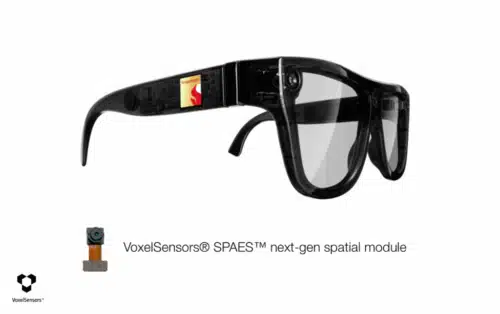
VoxelSensors have developed Single Photon Active Event Sensor (SPAES) technology to address this. Compared to standard depth sensors, SPAES uses up to ten times less power, lowers latency, and gives steady performance across changing environments. For engineers, this means more flexibility when designing compact systems where battery life, responsiveness, and reliability are important.
The technology also supports an emerging need: Physical AI, systems that learn from a user’s point of view. By capturing the world as the user sees and interacts with it, sensors like SPAES make it possible for XR devices to predict intent, adjust responses, and adapt continuously. To make this work, sensors must provide accurate 3D data under variable lighting and low power limits.
To help engineers bring these features into products, VoxelSensors is working with Qualcomm Technologies. SPAES integrated with the Snapdragon AR2 Gen 1 Platform provides a low latency 3D event data stream. Applications include eye tracking and personal AI agents inside XR headsets and glasses.

“We are pleased to collaborate with Qualcomm Technologies,” said Johannes Peeters, CEO of VoxelSensors. “After five years of developing our technology, we see our vision being realized through optimizations with Snapdragon XR Platforms. With our sensors that are ideally suited for next-generation 3D sensing and eye-tracking systems, and our inference engine for capturing users’ egocentric data, we see great potential in enabling truly personal AI agent interactions only available on XR devices.”
The company is also working to shrink SPAES further, making it easier to use in commercial designs. For engineers, this opens a path to building XR systems that are lighter, efficient, and practical for daily use. The collaboration with Qualcomm Technologies shows how SPAES can help XR systems move toward broader adoption.