What happens when a robot loses half its sensing power? This system keeps tracking odors by adapting its behavior, showing a way to handle sensor failure.
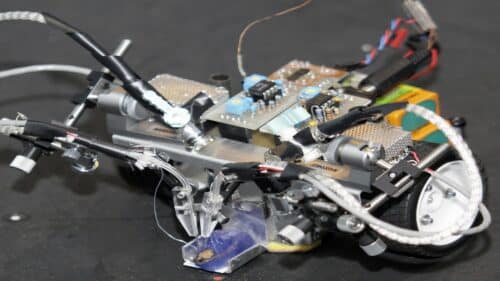
Robots that track smells often stop working when a sensor fails, but researchers have built a system that continues to operate even after losing half of its sensing ability, inspired by insect navigation. A team from the National Institute of Informatics, Science Tokyo, and Tohoku University has developed a robot that can find odor sources indoors and outdoors with accuracy, even if one of its two sensors stops working.
The design is inspired by the silkworm moth, which can locate mates using pheromones even after losing one antenna. This behavior is translated into a robotic framework that adapts to incomplete sensory input instead of failing. In tests, the robot maintains the same level of performance before and after one sensor is disabled, marking a shift from systems that rely on inputs from both sides.
Most existing odor-tracking robots assume that both left and right sensors function equally well. In real-world conditions, this assumption often fails due to damage or interference, leading to a drop in performance. The new system addresses this by mimicking how insects adjust their behavior. Instead of depending on symmetry, the robot interprets signals from the remaining sensor and adjusts its movement. Studies on adult male silkworm moths show that even with one antenna, they can still reach odor sources by combining odor detection with movement direction and changing their behavior.
This strategy is implemented in a robotic platform with olfactory sensing and tested in indoor setups and outdoor environments. The robot maintains search performance and a success rate even under sensor impairment, navigating disturbances while locating the odor source. This approach reflects a shift in robotics, where biological systems are used to design machines that are more adaptable. Such odor-tracking robots can be applied in disaster response to locate survivors or leaks, as well as in explosive detection and environmental monitoring. By focusing on how organisms solve problems, this work opens a path for designing systems that function under imperfect conditions.