The soft robot moves like a squid using water jets. It swims, checks the ocean, and helps explore without harming fish or coral.
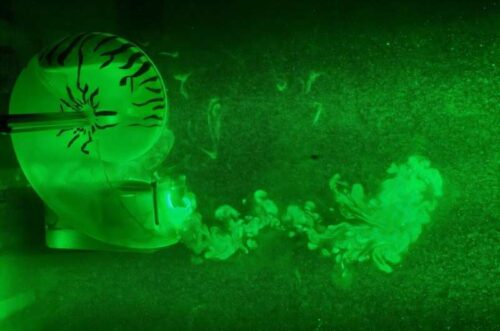
A fully soft underwater robot called RoboNautilus is setting a new benchmark in marine exploration by mimicking the pulsed jet propulsion of cephalopods. Developed at the University of Connecticut (UConn), RoboNautilus uses multilayer dielectric elastomer actuators (DEAs) to jet water through a soft siphon—achieving efficient, controllable movement without any rigid motors or bulky hydraulics.
Designed for quiet, continuous swimming, environmental sensing, and ecological monitoring, RoboNautilus operates with minimal disturbance to marine life. Its solid-state actuators deform in response to high voltage, enabling thrust while keeping the structure entirely soft and compact. This makes the robot especially well-suited for exploring fragile underwater habitats where conventional machines might cause damage.
The robot includes an onboard camera and sensors that record temperature and salinity during shallow-water trials. The soft outer shell—3D printed and modeled after Nautilus belauensis—houses redesigned compartments for electronics and air chambers that provide buoyancy and passive self-righting. At the front, a flexible DEA membrane mimics a cephalopod’s mantle, expanding and contracting to draw in and force out water for propulsion.
RoboNautilus stands out by solving a long-standing challenge in soft robotics: replicating cephalopod jet propulsion using entirely soft components. Previous designs often depended on rigid or hydraulic systems, which compromised the flexibility and safety of underwater robots. With RoboNautilus, soft DEAs eliminate this tradeoff, allowing precise motion in a fully soft body.

Future versions of RoboNautilus may include thrust vectoring, autonomous navigation, and enhanced sensing to support more advanced underwater missions. Beyond research, the team plans a STEM outreach initiative where high school students will design and test new shell shapes. By merging extinct Nautilus forms with modern robotic parts, students will explore hydrodynamics, structural durability, and robotic function—bringing ancient marine biology into modern engineering practice.
Through the combination of soft materials, silent propulsion, bioinspired design, and public engagement, RoboNautilus opens new possibilities for sustainable underwater robotics aimed at environmental research, education, and conservation.