




Imagine a robot that grows like a vine, wrapping around objects or people to lift them safely. It can handle fragile or heavy items gently.
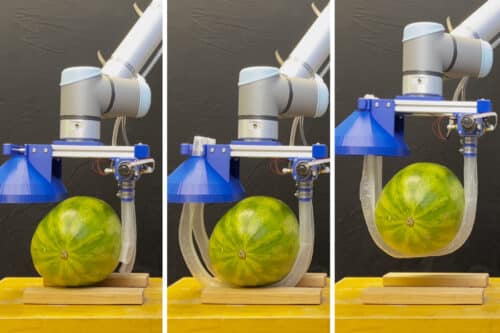
Some vines are surprisingly strong, using their woody tendrils to twist around obstacles and even pull down fences or trees. Inspired by this natural grip, engineers at MIT and Stanford have created a robotic gripper that can wrap around and lift objects gently from glass vases to watermelons. A larger version can even lift a human from bed safely.
The robot uses a pressurized box to inflate long, vine-like tubes that grow, twist, and coil around a target. Once secured, the vines are clamped and wound back, lifting the object in a soft, sling-like grasp. Tests show it can handle fragile and heavy items while navigating tight or cluttered spaces, offering a gentle, flexible alternative to traditional grippers.
Applications range from crop harvesting to moving cargo, with near-term focus on eldercare, where inflatable vines could lift a person from bed. Made from thin, sturdy pneumatic tubes that grow from their tips, the robot can twist, bend, and snake through complex environments.
Vine robots, once used mainly for safety inspections and search-and-rescue, have been adapted for eldercare to lift people from bed safely. Unlike traditional patient lifts, which require manually repositioning a person onto a hoisted sheet, the vine-inspired design wraps around a person to form a sling. This works thanks to a new ability missing in earlier designs: transforming from an open to a closed loop. While traditional vine robots can extend and bend freely, closing the loop lets the robot secure a sling and lift gently.
The system uses open- and closed-loop actions. In the open-loop stage, the robotic vine grows and twists around an object to grasp it, then forms a closed loop that retracts to lift it safely. A large-scale version demonstrated lifting a person from a bed, with pressurized tubes extending under and around the body, threading through clamps, and winding back to lift gently in a sling-like grasp.
A smaller version on a robotic arm has lifted heavy and fragile objects, including a watermelon, glass vase, kettlebell, metal rods, and a playground ball, while navigating cluttered spaces. This vine-inspired design offers flexible, gentle, and safe handling, with potential uses from eldercare to cargo handling, warehouse automation, and crane operations.
