A new fabric lets people talk to AI through their clothes, solving the problem of bulky wearables and enabling simple, hands-free interaction in daily life.
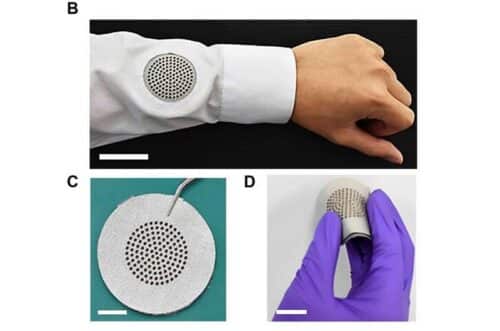
People may soon be able to talk to AI chatbots through their clothes. The technology aims to fix a problem that has limited wearable devices for years — bulkiness and low accuracy in detecting natural voices.
Many wearable sensors today are rigid, uncomfortable, or fail to recognize soft or normal speech. A team of international researchers has developed a new voice-sensing fabric called A-Textile to tackle this issue. The fabric turns ordinary clothing into a microphone. It’s a flexible patch that can be sewn or attached to everyday garments such as collars or sleeves, allowing users to speak directly to their clothing to interact with systems like ChatGPT or smart home devices.
The fabric works using the science of triboelectricity — the same effect that causes static electricity. Built in multiple layers, A-Textile generates a small electric charge when its layers rub together. When someone speaks, sound waves make these layers vibrate, producing an electrical signal that carries the person’s voice.
To enhance this signal, the international team embedded tiny flower-shaped nanoparticles within the fabric. These nanoparticles help hold the electric charge longer, strengthening the signal and improving the clarity of captured speech. As a result, the fabric can accurately transmit voice commands for AI systems to process.
Once generated, the electrical signal is sent wirelessly to a connected device such as a smartphone or computer. A deep learning model developed by the researchers then recognizes the voice commands and executes them. Because A-Textile can be added to existing clothing without requiring any redesign, it offers flexibility and practicality for everyday use.
During testing, the fabric produced an output of up to 21 volts and achieved a 97.5% accuracy rate in recognizing commands, even in noisy environments. It successfully interacted with AI systems and controlled smart home appliances, such as switching a lamp on and off, through simple voice instructions.
The international researchers believe this is only the beginning. By merging voice-based AI systems with clothing, future applications could include hands-free communication, health monitoring, fitness tracking, and personal assistance — all built directly into what people wear every day.