A technique called HydroSpread forms ultrathin films directly on water, allowing engineers to build insect-like robots for movement, sensing and control in liquid environments.
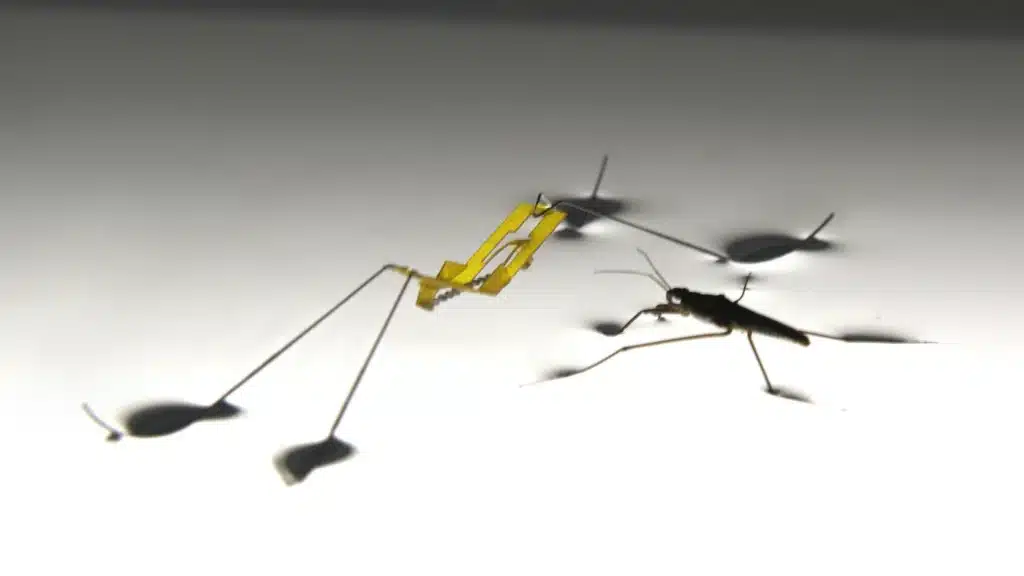
Researchers develop insect inspired robots that move across water. They point to new ways of monitoring floods, pollutants and aquatic environments without relying on large or rigid machines.
Two prototypes demonstrate the concept. hydroFlexor propels itself with paddle-like motions, while HydroBuckler moves with buckling legs similar to water striders. Both rely on heat driven layered films that bend and contract when exposed to infrared sources.
Switching the heat on and off controls their motion, allowing changes in speed and direction. This matters as it proves controlled and repeatable movement at a very small scale, which is a key requirement for deployable micro-robots.
The fabrication process enables the films to form directly on water surfaces. Droplets of liquid polymer naturally spread into uniform sheets, which are then cut into patterns using a laser. This method avoids the fragile step of transferring films from rigid surfaces, which has been a major source of error and limitations in soft robotics manufacturing.

The researchers from University of Virginia School of Engineering and Applied Science demonstrate multiple patterns, including strips, circles and other intricate shapes. The films remain stable while floating and can be integrated into devices that operate in liquid environments, enabling devices thin enough to float yet durable enough for motion and control.
HydroSpread method supports applications in wearable medical sensors, flexible electronics and environmental monitoring, where thin and adaptable materials are essential.