




Can hidden hotspots inside chips finally be tracked? An imaging method maps heat movement across multilayer electronics with microscopic precision.
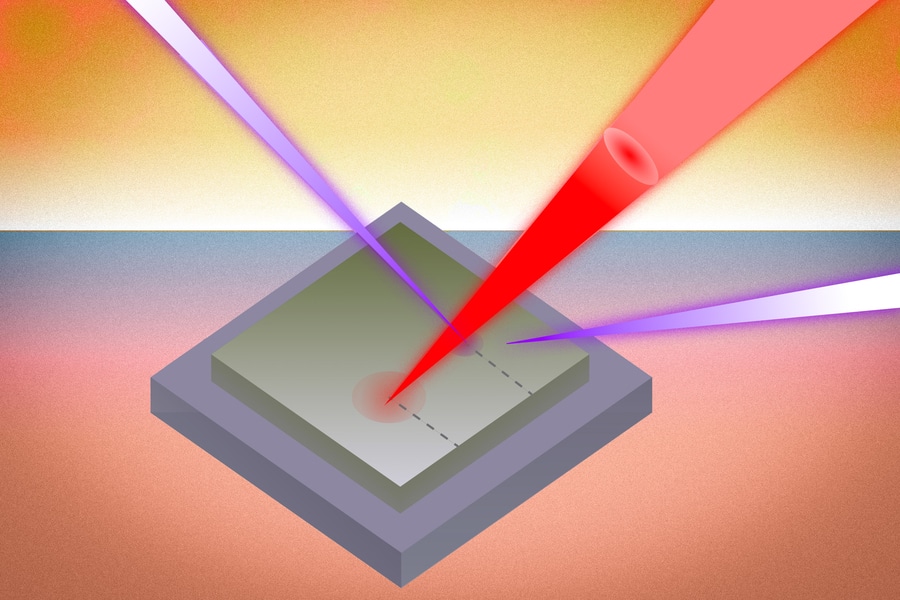
Researchers at the Massachusetts Institute of Technology (MIT) have developed a technique to measure how heat moves through multilayer electronic materials, offering a new way to analyse thermal behaviour in advanced semiconductor devices. The approach combines ultrafast X-rays with laser pulses to observe heat transfer across buried material layers, enabling measurements that conventional thermal characterisation methods cannot achieve.
As transistors continue to shrink and chip power densities increase, managing heat has become a major challenge for processors used in AI systems, data centres and high-performance electronics. Existing techniques often provide only an average thermal response or are limited to surface measurements, making it difficult to identify how heat propagates through individual layers within complex device structures. The new method addresses this limitation by capturing heat flow with microscopic spatial resolution across multiple material interfaces.
The researchers used laser pulses to heat a sample while ultrafast X-rays penetrated the device and measured atomic-scale strain as heat dissipated in real time. The technique was demonstrated on a gallium nitride layer integrated with silicon, a material combination widely investigated for next-generation transistors and flexible electronics. Measurements revealed that a single micron-scale wrinkle defect reduced local heat transfer by a factor of four and caused heat to spread unevenly across the material. The study also recorded a 25 per cent reduction in heat dissipation across material interfaces, highlighting the impact of processing-induced defects that are difficult to detect using existing approaches.
The team believes the method could help researchers identify thermal bottlenecks, understand failure mechanisms and optimise device layouts for improved heat management in future semiconductor technologies.
Mingda Li, associate professor of nuclear science and engineering at the Massachusetts Institute of Technology says, “I think overheating has become the real bottleneck in device performance. This approach is a step in that direction.”
