Researchers at the Institute of Science Tokyo have developed a tunable spinel-type sulfide semiconductor that emits light from violet to orange and switches between n-type and p-type conduction—paving the way for more efficient LEDs and solar cells that bridge the long-standing “green gap.”
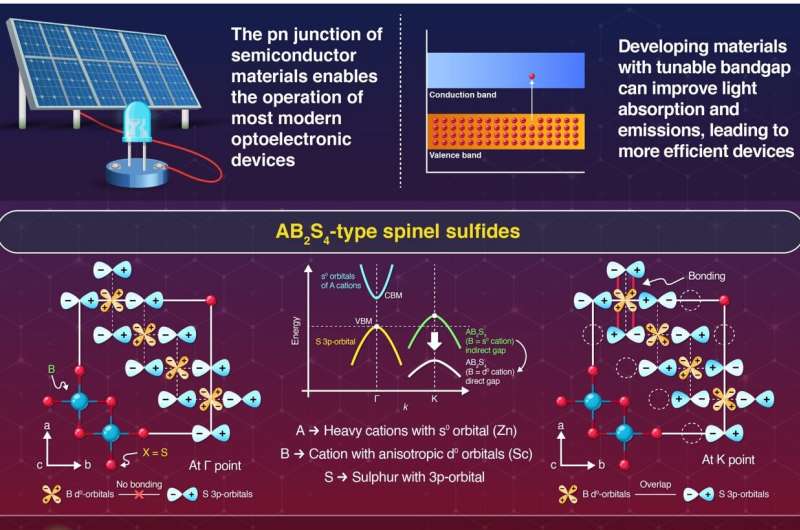
A new class of spinel-type sulfide semiconductors capable of emitting light across the violet-to-orange spectrum at room temperature could revolutionize future LED and solar cell technologies. Developed by researchers at the Institute of Science Tokyo, the material—(Zn,Mg)Sc₂S₄—can be chemically tuned to switch between n-type and p-type conduction, a breakthrough that opens the door to building efficient pn homojunction devices.
The discovery addresses long-standing challenges in optoelectronics, particularly the so-called “green gap,” where conventional LED materials such as InGaN and AlGaInP lose efficiency. By enabling both light emission and photovoltaic performance, this new material may offer a practical alternative to current semiconductors like gallium arsenide (GaAs) and silicon—each limited by trade-offs between light emission and current generation.
The study was led by Professor Hidenori Hiramatsu and Associate Professor Kota Hanzawa of the Materials and Structures Laboratory, alongside Distinguished Professor Hideo Hosono of the MDX Research Center for Element Strategy. Their work demonstrates that the (Zn,Mg)Sc₂S₄ system combines structural stability, tunable conductivity, and direct bandgap emission—all key attributes for next-generation optoelectronic devices.
In spinel-type sulfides (AB₂S₄), the specific atomic arrangement allows the conduction band minimum to form at the Γ point, promoting direct light emission. The Tokyo team leveraged this property by substituting magnesium for zinc to fine-tune the emission color—from orange to green to blue—and by adjusting titanium and zinc levels to control conductivity type. This chemical control achieved a dramatic range in conductivity—spanning nine orders of magnitude—from an insulating to a semiconducting state.

Hiramatsu notes that this versatility makes (Zn,Mg)Sc₂S₄ ideal for both efficient green light emission and solar energy absorption. With its broad tunability and room-temperature operation, the new spinel-type sulfide semiconductor could help close the “green gap” and power a new era of sustainable optoelectronics.