




By addressing long standing power and latency constraints, the research highlights a practical pathway toward scalable, flexible wireless infrastructure for future communication systems.
As connected devices, data centres, and automated systems generate and exchange ever larger volumes of data, existing wireless technologies are approaching their practical speed and power limits. While fibre optic cables offer high throughput, their physical complexity and energy cost restrict flexibility in dense urban infrastructure, manufacturing floors, and next generation computing environments.
Engineers at the University of California, Irvine have developed a silicon chip wireless transceiver capable of operating at data rates comparable to fibre optic links. The device pushes radio frequencies into the 140 gigahertz range and is designed to support emerging 6G and Future G communication needs while reducing power consumption.
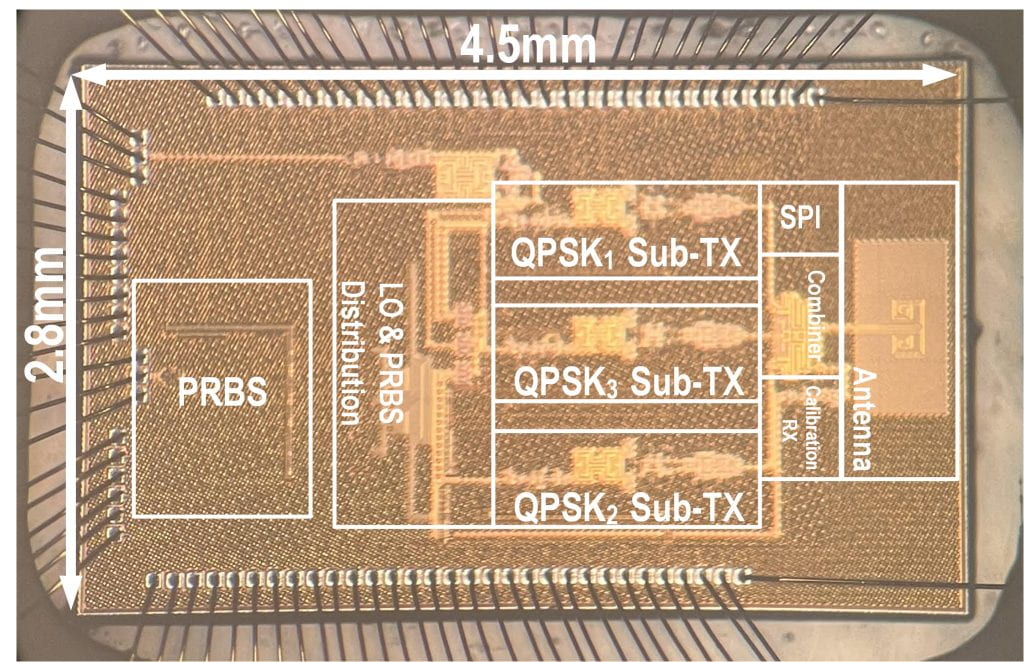
The transceiver combines a transmitter and receiver on a single silicon platform and uses a blended analog and digital architecture to process data more efficiently at extremely high speeds. Instead of relying heavily on power intensive data converters, the design shifts much of the signal processing into the analog domain. This approach allows digital information to be converted directly into radio frequency signals and recovered on the receiving end with fewer energy losses. By removing common bottlenecks associated with conventional wireless circuits, the system achieves end to end data rates of up to 120 gigabits per second while maintaining manageable power levels.
Key features of the research include:

- Operation in the 100 gigahertz frequency range
- Data transfer speeds reaching 120 gigabits per second
- Reduced reliance on power intensive signal converters
- Energy efficient transmitter and receiver architecture
- Compatibility with standard semiconductor manufacturing
- Potential use in data centers connected systems and automation
Payam Heydari, Chancellor’s Professor of electrical engineering and computer science, “We call this technology a wireless fibre patch cord because it offers the blistering speed of fibre optics without the physical cables. Our innovation eliminates the need for miles of complex copper wiring inside data centres.”

