A chip combines Bluetooth, vehicle communication, and control features for digital keys, in-car devices, and vehicle electronics.
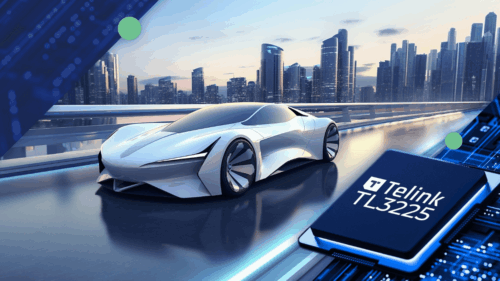
Telink has introduced the TL3225 family of wireless SoCs for automotive applications such as digital key fobs, body domain control, and in-cabin communication.
The SoC combines two RISC-V cores, Bluetooth 6.1 Channel Sounding, two CAN-FD interfaces, and two LIN interfaces. It supports centimetre-level ranging and is qualified to the AEC-Q100 automotive standard.
The dual-core design allows different workloads to run at the same time. Separate hardware and software partitions help the SoC run Bluetooth software, vehicle communication and other functions while maintaining real-time response.
For vehicle networking, the TL3225 has two CAN-FD channels and two LIN interfaces. CAN-FD handles higher-speed communication between vehicle systems, while LIN supports lower-speed functions. The LIN interfaces also include sleep and wake-up functions.
The SoC uses Bluetooth 6.1 Channel Sounding for distance measurement between devices. It can support applications such as passive entry and start, in-cabin device detection and Bluetooth-based vehicle access.
The TL3225 is AEC-Q100 qualified and is designed to operate across the automotive temperature range. It also includes EMC features for operation in the electromagnetic environment of a vehicle.
The company is providing evaluation boards and an SDK with the SoC. The boards can be used to test RF performance, power consumption and vehicle communication interfaces. They also support debugging, flash programming and power testing. The SDK includes Bluetooth software and software for vehicle access applications.
The SoC combines wireless ranging, vehicle communication and control functions on one chip. Telink lists digital key fobs, passive entry and passive start (PEPS), tyre pressure monitoring systems (TPMS), in-cabin Bluetooth sensing, wireless battery management systems and body domain control units among the possible applications.
The integration can reduce the number of separate components required in these systems and simplify hardware design for automotive electronics.
Click here for the original announcement.