A new battery keeps power strong in cold, wearable, and grid devices. It lasts longer, works better, and can be made cheaply for large-scale use.
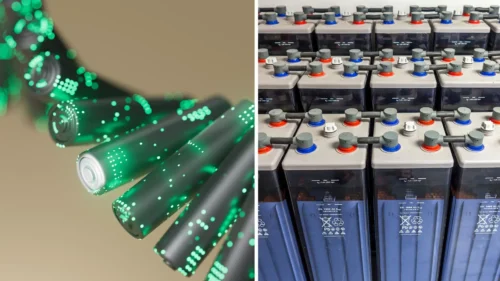
Cold environments, wearable electronics and grid storage systems need batteries that don’t lose power, freeze or break down after repeated use. Aqueous zinc-ion batteries are safe and inexpensive but fail to deliver steady performance in low temperatures and often lose capacity over time. To solve this, researchers from The Hong Kong Polytechnic University and Shenzhen University have redesigned the battery cathode to make zinc-ion batteries more stable and energy-dense across a wide temperature range.
They developed a new material by adding potassium ions and carbon nitride into the vanadium oxide structure of the cathode. This creates more space between the layers, reducing the pull on zinc ions and allowing them to move more freely, which speeds up reactions. With larger spacing between layers and more oxygen vacancies, the battery keeps its structure even during long-term use and in extreme conditions.
This makes the technology useful for engineers working on cold-climate electronics, wearable devices and scalable grid storage, where consistent performance and durability matter most. The material can be produced using low-cost hydrothermal and stirring methods, making it practical for mass manufacturing.
The study also shows that the right amount of carbon nitride is important for efficiency. Too much or too little reduces performance. Simulations and experiments confirm that this combination improves battery capacity, stability and makes it easier for zinc ions to move inside the cathode.
The work also lays the foundation for future cathode designs using similar co-intercalation strategies in layered vanadates. The team plans to test other co-intercalants and fine-tune electrolytes to push the performance even further across wider temperature ranges.