




Unlike traditional SBCs, the new edge boards blend CPU, GPU, and NPU in one hybrid system. From robotics to outdoor IoT, a fresh architecture is promising speed and rugged reliability. But what makes it possible?
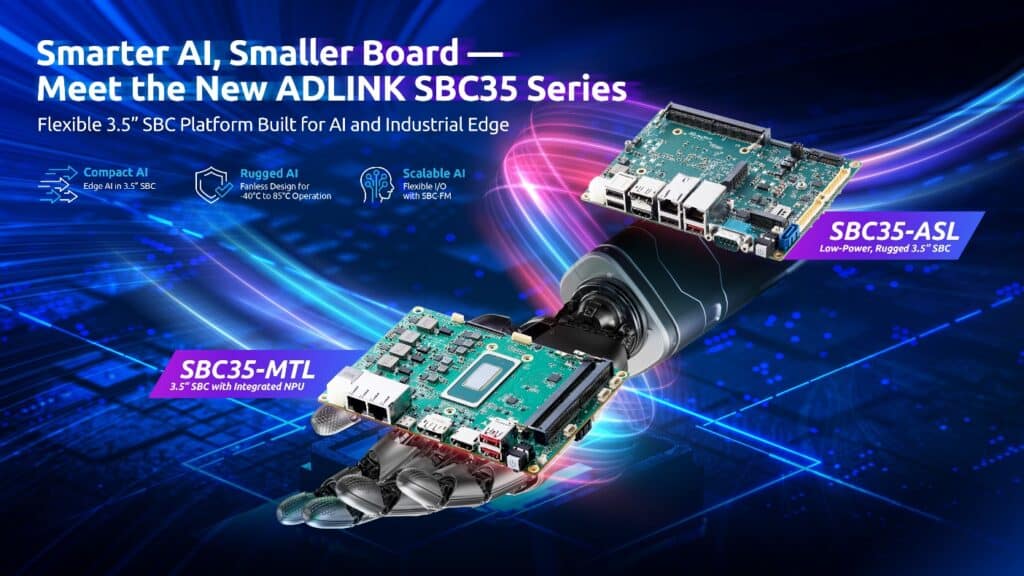
Edge computing is changing fast, much faster than most engineers ever imagined. And as industries rush to push AI closer to sensors, robots, and real-world machines, an uncomfortable truth has emerged: the Single Board Computers (SBCs) everyone has been relying on are starting to crack under pressure. They overheat. They choke on multi-camera feeds. They can’t scale. And when deployments get rugged, really rugged they simply don’t survive. During exclusive conversation of EFY’s Akanksha Sondhi Gaur’s with ADLINK’s Venkatesh K., Connie Hsiao, Dave Yu and Julie Huang, it became clear that these weren’t occasional issues. These were everyday battles customers were losing.
So the obvious question was: how do you redesign an SBC so it performs like a server, behaves like an AI accelerator, fits into a palm-sized board, and still survives blazing heat, dust, vibration, and unstable power? ADLINK’s answer turned out to be far more radical than expected.
Instead of simply boosting specs, they rebuilt the entire architecture. Their 3.5-inch SBC platform powered by Intel Core Ultra with an integrated Neural Processing Unit (NPU) on one side, and the rugged Atom x7000RE on the other uses a hybrid compute engine where Central Processing Unit (CPU), Graphics Processing Unit (GPU), and NPU work like a synchronized system. Heavy AI vision and analytics run on CPU/GPU, while lightweight inferencing silently shifts to the NPU. It feels almost orchestral every component playing exactly when it’s needed, never wasting power or time.
Then came the twist: I/O that isn’t fixed. ADLINK introduced function-module–based expansion using flexible Flexible Printed Circuit (FPC) cables, letting Original equipment manufacturers (OEMs) swap, redesign, or fully customize I/O without ever touching the core board. Need more USB? More Digital Input and Digital Output (DI/DO)? Rugged circular military-grade connectors? A custom layout no competitor offers? Suddenly all of it becomes possible, something almost unheard of in the 3.5-inch SBC world.
And just when we thought we’d covered the biggest innovations, they revealed the thermal secret. Instead of cooling the board, they cool the whole system. The enclosure itself acts as a heat sink, enabling fanless operation even under AI loads, while every component from connectors to regulators is selected to survive –40°C to +85°C environments, shock, vibration, and dirty industrial power rails.
The suspense didn’t end there. ADLINK hinted at what’s coming next: Intel Panther Lake SBCs with up to 150 Trillions of Operations Per Second (TOPS) of Artificial Intelligence (AI) power, CPU-GPU-NPU fused into a single package, and native Mobile Industry Processor Interface (MIPI) camera interfaces built for Advanced Driver Assistance Systems (ADAS), robotics, and next-gen AI vision. They also teased new camera kits and drivers that may dramatically simplify field deployment. What we’ve shared here is just the surface.
For the full story, deeper insights, and every detail stay tuned for the complete interview.


