What if we could sense the invisible? With next-gen TMR sensors hitting picoTesla sensitivity, healthcare, wearables, and even quantum tech are about to change forever.
Magnetic fields are all around us, yet we rarely notice them. To measure and understand them, we need sensors capable of capturing signals far too weak for the human senses. This is where tunnelling magnetoresistance (TMR) sensors step in. By using the quantum tunnelling effect between ultra-thin magnetic layers, these sensors translate invisible magnetic fields into measurable electrical signals, giving us a powerful way to detect what was once out of reach.
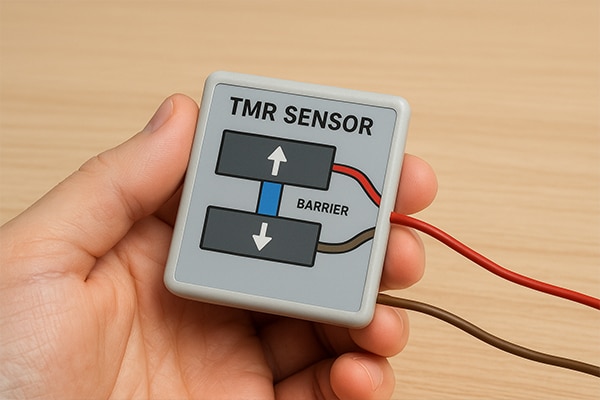
We have reached a breakthrough with TMR sensors, with a 1000x improvement in sensitivity that allows us to detect magnetic fields at the picoTesla scale—a range once inaccessible to mainstream technology. This advancement means our ability to measure magnetic fields is no longer confined to traditional uses, unlocking opportunities in healthcare, wearable devices, and quantum computing.
When discussing the achievement of this level of performance, two key design considerations emerge. The first is size. If the sensors are not small enough, they cannot be fitted into all the places we want, whether in consumer gadgets, medical devices, or other portable technologies. The second is power. For wearables and portable devices, every bit of energy matters, unlike in cars, where power is less of an issue. Keeping the sensors both small and energy-efficient is what makes next-generation TMR sensors truly practical.
| TMR sensing as an end-to-end solution |
| TMR sensing is evolving beyond being just a sensor. It is becoming a full end-to-end solution. A 1000x performance gain is achieved by combining three elements: 1. Improved TMR stacks: Optimised at the sensor level for higher sensitivity 2. ASIC integration: Placed close to the sensor to amplify, filter, and digitise signals at the source, reducing noise 3. Artificial intelligence: Used downstream to distinguish signals of interest from interference, enabling real-time noise reduction This pipeline approach allows TMR sensors to perform tasks previously impossible outside controlled environments. For example, when worn on the chest, the integrated system can detect arrhythmias or predict cardiac events at home. Other potential applications include gesture recognition, fall prediction in elderly individuals, and monitoring disease progression, all of which can be leveraged through the rapid progress of AI. |
What can TMR sense next?
Think about gesture recognition. Imagine placing tiny TMR sensors on your skin. As you move your hand or flex a muscle, those movements generate magnetic signals. The sensors pick them up, and with the help of machine learning, we can map those signals to specific gestures. What is even more exciting is that AI filters out the background noise, leaving us with only the signals that matter. Suddenly, we are talking about powerful new ways to build wearable human-machine interfaces.

In healthcare, TMR sensors have mostly been used as switches, for example, in continuous glucose monitoring. But once we use them as true analogue sensors that can linearly measure magnetic fields, the game changes. They can pick up biomagnetic signals from the body, such as heartbeats or muscle activity. Early experiments have already shown TMR sensors detecting cardiac signals. The challenge? These tests were usually carried out in laboratories with large, complex setups. Now, the real task is making them small and scalable so they fit into something you and I could actually wear.
This is where progress gets exciting. Today’s TMR sensors measure just a few millimetres across, small enough to fit into flexible wearables or even be woven directly into clothing. Unlike traditional sensors, they do not need to touch your skin, opening up new ways to monitor health continuously and comfortably.
Of course, TMR sensors are not here to replace every sensor we use today. They are here to complement them. For example, they will not measure body temperature, but they could track heart rate or even estimate blood pressure simply by sensing magnetic fields from cardiovascular activity. This makes them ideal for next-generation wearables where multiple sensors work together to provide meaningful health insights.
Looking further ahead, another field where TMR sensors could shine is quantum technology. Measuring currents at incredibly small scales requires sensors that are both highly sensitive and compatible with semiconductor processes. This is exactly where sub-10-picoTesla TMR sensors come in. They can detect magnetic fields that are so weak, they are generated by neural or muscular activity, signals that most conventional sensors cannot detect. Combine that sensitivity with their small size and scalability, and TMR sensors become strong candidates for future quantum computing systems once paired with quantum hardware developers.
The race to what’s next
When we look at who is leading in TMR sensor technology, we see different companies driving progress in different ways. Allegro MicroSystems, for example, has shown how much noise performance can be improved. Their XtremeSense TMR sensors cut noise levels compared to both earlier TMR devices and Hall-based solutions, which translates into more efficient power conversion. For us, that matters in real systems like solar inverters, heat pumps, and EV chargers, where every bit of efficiency adds up.
TDK Corporation offers another perspective on what TMR sensors can achieve. Their 360° angle sensor demonstrates how this technology can precisely measure rotor position in BLDC motors. These are motors we depend on in safety-critical applications such as traction motors, brake boosters, and power steering. What stands out is the sensor’s ability to remain accurate across a wide range of temperatures and over time, while still operating reliably in extended magnetic-field ranges. It reminds us that TMR is not just about sensitivity; it is also about stability and trust in challenging environments.
And when it comes to pushing boundaries, Neuranics is taking us into uncharted territory: picoTesla sensitivity. While most commercial sensors stop at the nanoTesla range, they are working on detection down to 1 picoTesla per √Hz at 1Hz. They have already demonstrated a four-channel system that operates effectively even in noisy magnetic environments.
This kind of sensitivity opens up entirely new areas to explore—whether in monitoring cardiac signals for healthcare, advancing quantum computing, or applying the technology in agriculture and robotics. Their emphasis on sensitivity, stability, smaller dimensions, and low power underlines what it takes to make these advances practical.
Key leaders in the high-sensitivity TMR sensing space include the stated examples, while other major magnetic sensor manufacturers, such as Infineon Technologies, Honeywell, and STMicroelectronics, remain active in the broader market. This shows that innovation is happening at multiple levels, with some companies driving breakthroughs in sensitivity and performance, and others building reliable solutions for established applications.
TMR sensors are no longer laboratory curiosities. They are becoming practical tools that enable us to measure and interact with the world in ways that were once impossible. We can now detect faint heart signals, track gestures, enhance power system efficiency, and even contribute to quantum technologies. As we refine their sensitivity, shrink their size, and reduce power consumption, these sensors are transitioning from experimental setups to everyday devices.
The journey is still unfolding, but one thing is clear: with TMR sensors, we are entering a future where invisible magnetic fields reveal powerful new insights and possibilities.
This article is based on a conversation with Kia Nazarpour, Chief Strategy Officer at Neuranics, Professor of Digital Health at the University of Edinburgh, with experience in industry R&D, and co-founder of Rebel Bionics, which develops prosthetics for children. It is written and curated by Nidhi Agarwal.