The 3D printing method uses eco-friendly materials to make parts that carry electricity. It could help build cheaper, greener, flexible electronic devices.
A team from the Singapore University of Technology and Design (SUTD) has created a new 3D printing technique that uses biodegradable materials to produce electrically conductive structures. The method could pave the way for more sustainable and low-cost electronics, from flexible circuits to soft sensors.
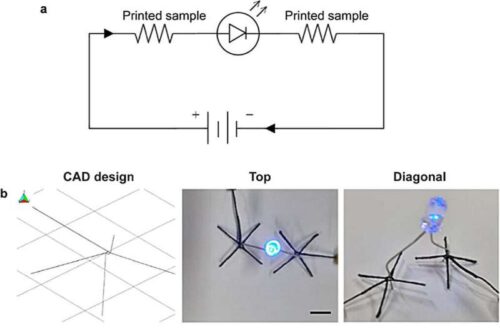
The team demonstrated that their printed materials could successfully power LEDs and form working circuits. They also printed complex overhanging spiral structures in a gel-based support medium—without needing extra scaffolding—showing the method’s ability to handle intricate shapes.
Unlike conventional methods, which struggle with high concentrations of conductive filler, this new approach can handle up to 60% graphite by weight while maintaining print quality and conductivity above 30 S/m. Most other techniques begin to fail at 30–50%, due to issues like nozzle clogging or shape distortion.
The innovation centers on a process called immersion precipitation. The researchers used direct ink writing at room temperature, with a custom ink made from cellulose acetate (dissolved in acetone) and graphite microparticles. When printed in air, the ink spread too much. But when extruded into water, the acetone was rapidly drawn out, causing the ink to solidify on the spot and retain its shape. This created precise, well-defined 3D structures.
This work is rooted in environmental goals. Cellulose acetate and graphite are biodegradable and widely available. Acetone, used as the solvent, is low in toxicity and breaks down easily in nature. Together, these materials form the basis for a greener way to manufacture electronics.
Next, the team plans to adapt this process for other material combinations and test long-term performance in real-world environments. Their broader aim is to establish a scalable, affordable platform for making sustainable electronic devices.