Smart in-cabin intelligence is quietly reshaping the driving experience—detecting fatigue,
fine-tuning comfort, and reinforcing safety without intruding on the journey.
In modern vehicles, in-cabin sensing refers to the use of various sensors to monitor what is happening inside the car. These sensors focus primarily on two areas: driver monitoring systems (DMS) and occupant monitoring systems (OMS).
DMS is used to track the driver’s behaviour, such as attention, drowsiness, or engagement with the vehicle, while OMS monitors passengers and their positions.
Together, these systems enhance safety and support new in-car features, making the driving experience both smarter and more responsive.
To build a complete picture of the cabin environment, modern vehicles rely on multiple types of sensors working in tandem. The most common are infrared cameras, which track faces and body movements.
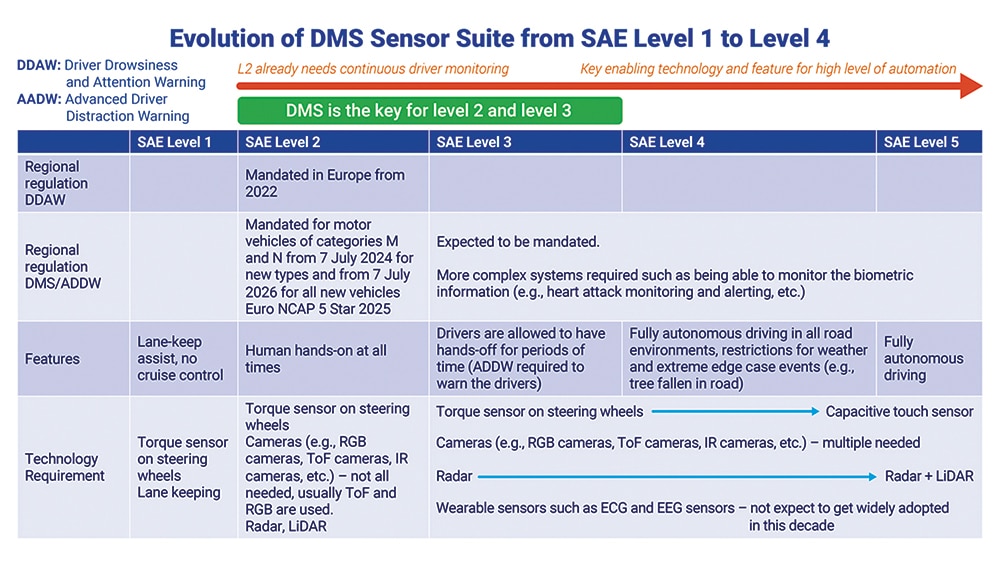
Some systems also use radars to detect presence and motion, torque sensors to check if the driver’s hands are on the wheel, and time-of-flight (ToF) sensors for tasks such as gesture control or depth sensing. Each sensor collects different types of data, which are then processed by dedicated algorithms.
Together, they give the vehicle a clearer understanding of what is happening inside the cabin, enabling features like automatic alerts, personalised settings, or even emergency interventions.
As vehicles become increasingly intelligent, understanding cabin activity is no longer optional—it is essential. From tracking the driver’s focus to recognising who is seated where, in-cabin sensing technologies are quietly transforming how cars respond to us.
Often built on a network of discreet but powerful sensors, these systems offer not just greater safety but a more responsive and tailored driving experience.
Before exploring the technical details, it is worthwhile to understand what in-cabin sensing entails and why it matters in today’s automotive landscape.
| Key Global Players |
| Seeing Machines (Australia): Software-focused Mobileye: Global presence, software and systems Cipia (Israel): Software provider Sony: Sensor hardware Magna: Tier 1 supplier involved in system integration |
Car’s hidden eyes and hand
Near-infrared (NIR) cameras are essential components in modern DMS. Paired with NIR LEDs, they project invisible light onto the driver’s face. This light, undetectable to the human eye, reflects back to the camera, allowing the system to track head position, eye movements, and blinking.
As NIR light is invisible, these systems function reliably in both day and night conditions, helping monitor driver alertness without distraction.
However, integrating NIR cameras into vehicles presents challenges. While higher-resolution cameras improve accuracy, the key hurdles lie in software and algorithms. With overlapping features across systems, companies focus on software that performs reliably across diverse real-world conditions and avoids false readings, often depending on large datasets for training.
Some systems now combine NIR with RGB cameras, which capture colour, while NIR provides detailed grayscale. This combination supports more features but adds complexity, as the software must process inputs from both sensor types.
Time-of-flight (ToF) cameras are another technology under exploration. Although less common in DMS, they are used in OMS for functions such as seat occupancy detection and gesture control. For instance, a second-row passenger could wave to lower a display screen.
ToF’s strength lies in capturing 3D depth data, but high costs—$50-$100 per unit—have hindered widespread adoption. Their broader use will depend on either cost reductions or a clear return on the added value.
Radar sensors, particularly at 60GHz, offer a distinct advantage: they can detect through soft obstacles, such as blankets. This makes them ideal for identifying rear-facing infants in car seats, even when visibility is limited. Tesla, for example, uses in-cabin radar in its Model Y to monitor rear passengers, reinforcing its safety-first approach.
To monitor hand presence on the steering wheel, torque sensors have long been the standard. They detect whether the driver is applying force to the wheel, a feature integrated into power steering systems. However, they have limitations—light hand contact may go unnoticed, and they can be tricked by weights simulating hand pressure.
To improve reliability, some automakers now use capacitive touch sensors, which detect skin contact rather than pressure. Inanimate objects cannot spoof these and are relatively low-cost, but they may fail if hands are wet, much like a damp touchscreen.
Both torque and capacitive sensors function well under normal conditions, but torque sensors remain more common due to their integration with existing hardware. For now, they are likely to remain the mainstream solution, with capacitive sensors providing added support in select models.
What works and what doesn’t