Single board computers have quietly become much more than compact controllers.
When a board now influences intelligence, longevity, and competitiveness, choosing one
is no longer an engineering detail; it is product vision.
Once chosen primarily for size and price, single board computers (SBCs) have become long-term platform decisions that directly define AI capability, system reliability, scalability, and product lifecycle. For today’s edge deployments, the SBC is no longer a peripheral choice; it is the architectural foundation on which intelligent systems are built.
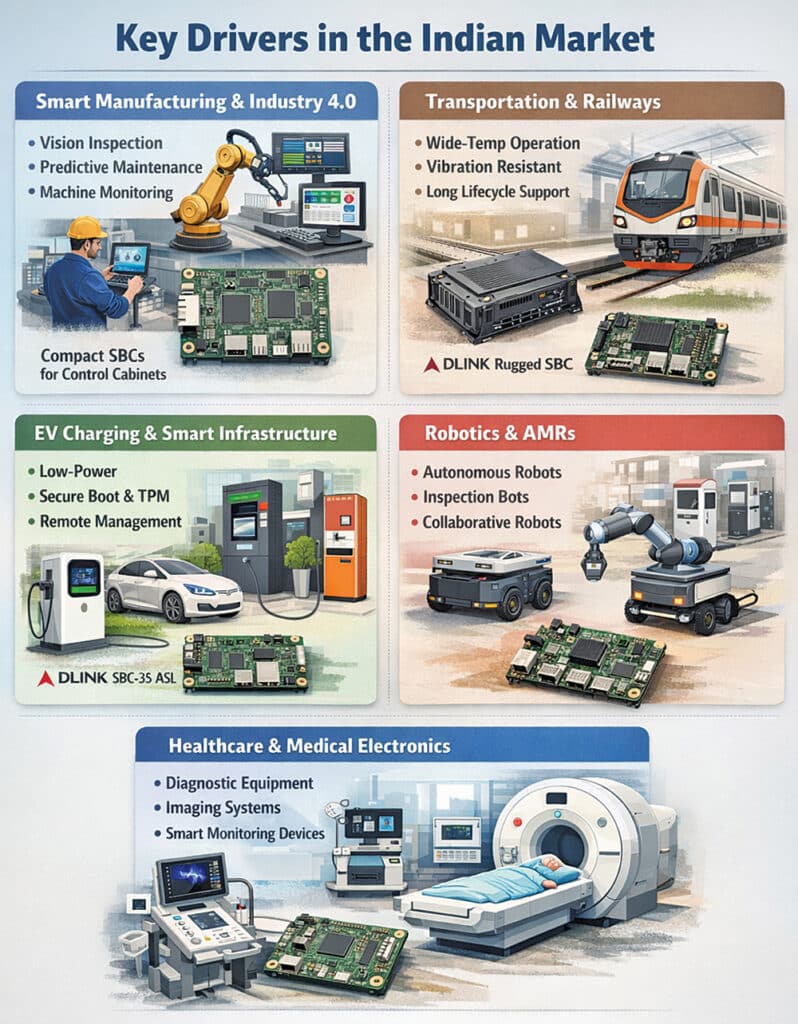
The traditional view of an SBC as a compact controller handling basic I/O and automation tasks is now outdated. Modern SBCs are running AI inference at the edge, orchestrating multi-sensor data, driving multi-display HMIs, and operating reliably in harsh industrial and outdoor environments far from the cloud. As Venkatesh K., Sr Sales Manager (India), at ADLINK, explains, “SBCs are no longer just control platforms; they are designed as edge AI engines where inference happens locally rather than in the cloud, enabling real-time decision-making across industrial, transportation, and automation applications”.
From factory floors and railway yards to robots, EV chargers, kiosks, and smart cameras, SBCs have become the intelligence layer of modern edge systems. This transformation has not happened accidentally. Vendors are fundamentally rethinking how these boards are architected, thermally managed, expanded, secured, and supported over long deployment life cycles.
| Why global SBC vendors are watching India closely |
| • Growing demand for edge AI over cloud dependence • Cost-sensitive but performance-driven market • Increasing preference for standard platforms with customisation • Long deployment lifecycles (10-15 years in many projects) For vendors like ADLINK, Advantech, and Kontron, India represents not just a sales market but a deployment laboratory for rugged, scalable edge systems. |
SBCs are becoming AI-native, not AI-ready