As electronics becomes increasingly complex, traditional reflow soldering is being replaced by a process that delivers cleaner solder joints, greater reliability, and improved performance in advanced circuit designs. But what exactly is vacuum reflow soldering?
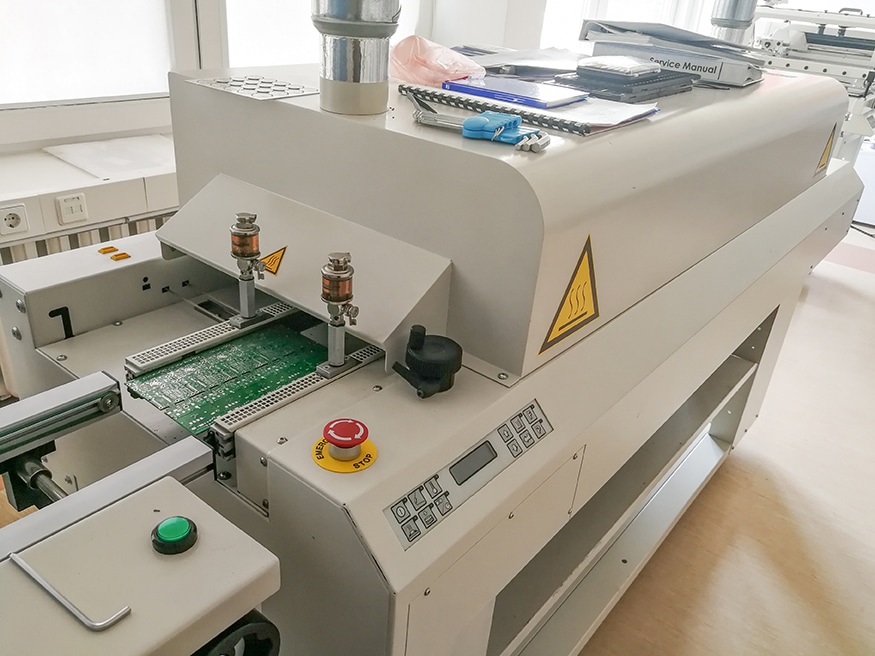
Al though not yet widely adopted, vacuum reflow soldering is emerging as an important process in high-reliability electronics manufacturing. As power densities increase and component packages become smaller, conventional reflow soldering often struggles with one persistent issue: solder voids.
These microscopic gas pockets trapped within solder joints reduce thermal conductivity, weaken mechanical strength, and can ultimately compromise the long-term reliability of electronic assemblies.
How do solder voids form
Voids typically form when gases released during flux activation, trapped air, oxide reduction, or large thermal pad geometries become trapped within molten solder during reflow. Once the solder solidifies, these gases remain trapped, creating voids that are difficult to eliminate using conventional processes.
Vacuum reflow addresses this challenge by applying a controlled vacuum while the solder is in its molten state. The reduced chamber pressure causes trapped gas bubbles to expand and escape before the solder solidifies, allowing the molten solder to flow into the resulting spaces. This results in denser solder joints with significantly lower void content, improved thermal conductivity, improved electrical performance, and greater mechanical reliability.
Inside the vacuum reflow process
Unlike conventional reflow, the vacuum is not applied throughout the entire heating cycle. The PCB first passes through preheating and heating zones until the solder melts. A short vacuum stage is then introduced before cooling begins. Applying the vacuum too early has little effect, while applying it too late allows voids to become permanently trapped. Synchronising the vacuum cycle with the solder’s liquid state is therefore critical to achieving optimum results.
In conventional surface-mount technology (SMT), excessive voiding can compromise joint integrity, reduce heat dissipation, and accelerate failures under thermal cycling, vibration, and mechanical stress. Vacuum reflow helps produce solder joints that can better withstand these demanding conditions. This makes the technology particularly suitable for electric vehicle (EV) power modules, radio frequency (RF) hardware, automotive electronic control units (ECUs), power semiconductors, medical electronics, aerospace systems, defence equipment, and telecom infrastructure.
| Table 1 Global vacuum reflow manufacturers | ||
| Manufacturer | Website | Headquarters |
| BTU International, Inc. | www.btu.com | USA |
| Heller Industries, Inc. | www.hellerindustries.com | USA |
| Kurtz Ersa GmbH | www.kurtzersa.com | Germany |
| Rehm Thermal Systems GmbH | www.rehm-group.com | Germany |
| Shenzhen JT Automation Equipment Co., Ltd | www.jt-int.com | China |
| SMT Wertheim GmbH | www.smt-wertheim.de | Germany |
| Suneast Technology Int’l Ltd | www.suneast1984.com | China |
| Tamura Corporation | www.tamuracorp.com | Japan |
| Table 2 Leading vacuum reflow suppliers/distributors in India | ||
| Supplier/Distributor | Website | Headquarters |
| ETA International Pte Ltd (I.C.T. Partner) | www.etasmt.com.sg | Bengaluru |
| Heller India (Heller Industries Rep) | www.hellerindustries.in | Chennai |
| Paar Automation | www.paarautomation.co.in | Hosur |
Use case: From aerospace to EVs
Originally developed for aerospace and defence applications, vacuum reflow is increasingly being adopted for high-value assemblies where joint consistency and reliability are critical. By reducing defects early in production, vacuum reflow helps streamline manufacturing, lowers rework, improves inspection yields, and increases process consistency.
The process combines precise thermal profiling with carefully controlled vacuum cycles, often using inert gases such as nitrogen to minimise oxidation and ensure proper solder wetting. Modern systems support a wide range of packages, including BGAs, QFNs, DFNs, IGBTs, power modules, and other fine-pitch components. Real-time monitoring of oxygen concentration, temperature profiles, vacuum pressure, and process data further helps manufacturers maintain consistency while meeting IPC-A-610 and MIL-STD quality requirements.
| Special Thanks to Our Advisory Panel |
| We thank Shrikant Borkar, our Advisor, and Narayan Kumar Jayaraman of Sanjay Technologies for their valuable technical guidance and insights in preparing this article on the latest advancements in vacuum reflow ovens. |
Performance and industry outlook
Both batch and inline reflow systems can accommodate complex assemblies, while lower oxygen levels and careful flux control contribute to more uniform and robust solder joints.
To support these applications, several manufacturers have developed specialised vacuum reflow systems with advanced chamber designs, process monitoring, and flux management capabilities. One example is TSM Co., Ltd’s TRV III vacuum reflow oven, which incorporates features such as a CAP-type vacuum chamber, finger-hook PCB transport, real-time oxygen and temperature monitoring, and an integrated flux management system to improve process consistency and reduce solder voiding.
“Traditional solder processes often struggle to keep voids consistently low,” says Phil Zarrow from Indium Corporation. “Vacuum reflow can push void rates towards single-digit levels, enabling stronger, more reliable solder joints.”
Depending on the solder alloy, package design, and process optimisation, vacuum reflow can reduce voiding by a factor of six to nine compared with conventional nitrogen reflow. Well-optimised processes can achieve void levels below 1% in many applications.
“Vacuum reflow is the next step in achieving a reliable reflow process for today’s miniature electronic assemblies,” says Narayan Kumar Jayaraman, Managing Director, Sanjay Technologies.
As circuit miniaturisation, process automation, and Industry 5.0 practices continue to advance, vacuum reflow is becoming an increasingly important manufacturing process because of its consistent quality and compatibility with modern production lines. Its ability to improve reliability, thermal performance, and process consistency is contributing to wider adoption across automotive, telecom, industrial power electronics, and other high-performance applications. Market forecasts indicate continued growth, particularly across automotive, telecom, and high-power industrial applications.
Saba Aafreen, Tech Journalist at EFY, blends on-ground industrial experience with a growing focus on AI-driven technologies in the evolving electronics industry.