


The bionic knee connects to bone and muscle. It helps users walk, climb, move, and feel like the leg is part of their body.
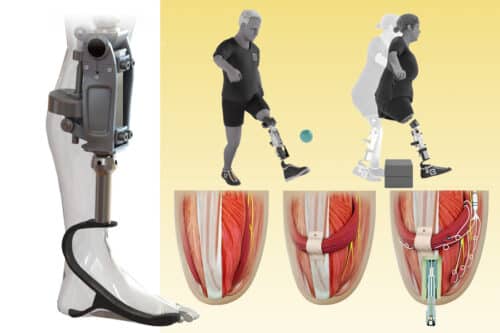
MIT researchers have developed a bionic knee system that helps people with above-the-knee amputations walk, climb stairs, and avoid obstacles more effectively than standard prosthetics. In early tests, users felt more in control and said the limb felt more like part of their body.

The prosthesis, called the osseointegrated mechanoneural prosthesis (OMP), uses two main technologies: a bone-anchored interface and a nerve-connected muscle system. These allow the artificial limb to respond to user intent and send feedback to the nervous system.
At the center of the system is a titanium rod implanted into the user’s thigh bone. This replaces the socket used in traditional prosthetics and improves mechanical stability. Sixteen wires run through the implant to collect signals from electrodes on nearby muscles.
These muscles are reconnected using a method called agonist-antagonist myoneuronal interface (AMI), which restores the muscle pairings that are usually lost during amputation. This lets the muscles send movement and position signals, which are picked up and sent to the prosthetic.
The full system includes a controller that reads the muscle signals and calculates how the artificial knee should move. In tests, users could better perform movements like bending the knee or stepping over objects compared to those using standard prosthetics.
Researchers tested three groups: two users with the full OMP system, eight with only the AMI surgery, and seven with neither. All used the same powered knee. The OMP users showed the most steady and accurate control.
The study also looked at how much the prosthetic felt like part of the user’s body, known as embodiment. Participants were asked if they felt like they had two legs, if the prosthesis felt like part of their body, and if they felt in control of it. OMP users reported a stronger sense of connection and control over time.
This suggests that linking prosthetics to both bone and muscle can help them feel more like natural parts of the body.
The AMI method is already in use for below-the-knee amputations and may become common for above-the-knee cases. The full OMP system still needs larger trials before it can be approved for wider use, which could take several years.