


This advancement paves the way for mass-produced quantum systems—bringing quantum computing, sensing, and communication closer to everyday reality.
For scalable quantum tech, researchers from Boston University, UC Berkeley, and Northwestern University have developed the first-ever electronic–photonic–quantum chip built entirely in a commercial semiconductor foundry. The chip, detailed in Nature Electronics, integrates quantum light sources with control electronics using a mainstream 45-nanometer CMOS process—bringing us closer to mass-producible quantum devices.
This achievement merges quantum optics, photonics, and electronics on a single silicon platform. “It’s a small but vital step in making repeatable, controllable quantum systems accessible through standard chip manufacturing,” said BU’s Miloš Popović, senior author of the study.At its core, the chip acts as a quantum light factory—using microring resonators to generate streams of correlated photon pairs, key resources for quantum computing, communication, and sensing. Each chip includes twelve such photon sources, working in parallel and stabilized through on-chip control logic and heaters.
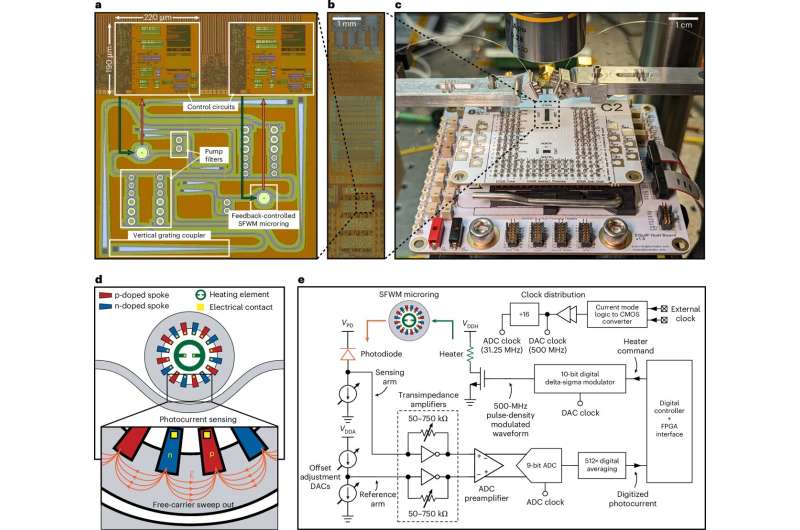
Maintaining the delicate photon-generation process is notoriously tricky. These microrings are extremely sensitive to heat and fabrication variations—tiny changes can throw off the entire system. To combat this, the team embedded photodiodes inside the resonators to monitor their alignment in real time. The chip’s control circuitry then self-adjusts, ensuring stable quantum light generation even as environmental conditions fluctuate.
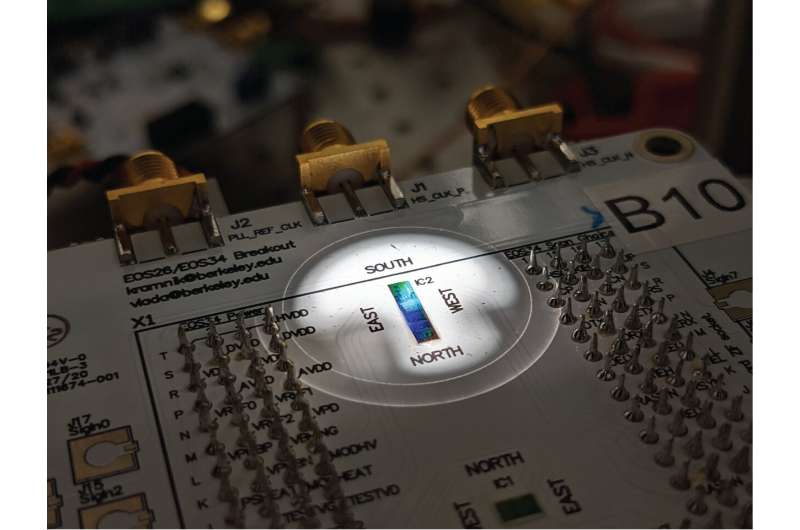
“This real-time stabilization of quantum sources on-chip is what makes this system scalable,” noted Northwestern Ph.D. student Anirudh Ramesh, who led the quantum measurements.What makes this even more groundbreaking is how the chip was made. Built using GlobalFoundries’ commercial 45nm CMOS platform, the same tech stack behind advanced AI interconnect chips, it proves that quantum systems can share fabrication pipelines with everyday electronics. “The challenge was making photonics quantum-ready without leaving the commercial process window,” said BU’s Imbert Wang.
UC Berkeley’s Daniel Kramnik, who led integration and packaging, summed it up: “We’ve shown that full quantum photonic systems—complete with stabilization—can be built in CMOS. That opens the door to large-scale deployment.” From secure quantum networks to next-gen sensing and computing, this chip could become the foundation for the quantum-powered world ahead.