What if light could carry hidden messages that only the right chip can read? This tiny chip might be the start of something big. Find out!
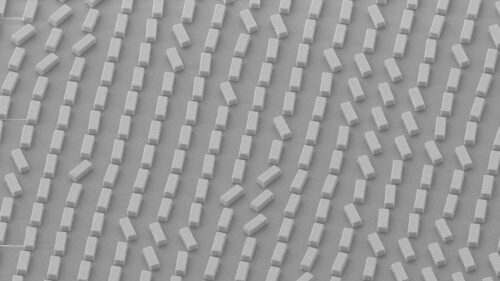
Researchers from EPFL, a research university in Switzerland, worked together to build a chip, not a regular chip, but a transparent one with Calcium Fluoride base (CaF2) and on top of this, a metasurface layer Germanium, where all the light gets twisted.
This twisting effect is called Chirality, light can also be left or right ‘handed’ where light gets circularly polarised. It is when light spirals as it travels, either left handed or right handed. Depending on the twist, the metasurface at the receiver end responds differently.
Chirility structure interacts with left and right polarized light differently. However , this effect is extremely weak, which makes precise control of chirality a challenging task.
If in the transmission side, the metasurface makes the light left circularly polarised (LCP) left and to get data from the light, at the receiver end the light shd be LCP to get the exact data of the transmitter, so that the light get depolarised only at the end, like a watermark or encrypted image.
In this experiment, the researchers encoded two different images at the same time on the metasurface. For the first time, they got the image data encoded in the size of mata-atoms, which represents the pixels and decoded with unpolarised light.
In EPFL’s experiment, the chip isn’t transmitting data over a network, acting more like a watermark or encryption key. With more development this tech could integrate into fiber optic network, data encryption, biosensing, and quantum technologies, drug composition or purity from small-volume samples.