The device achieves frictionless and high-speed motion in all directions, paving the way for future robots and precision tasks.
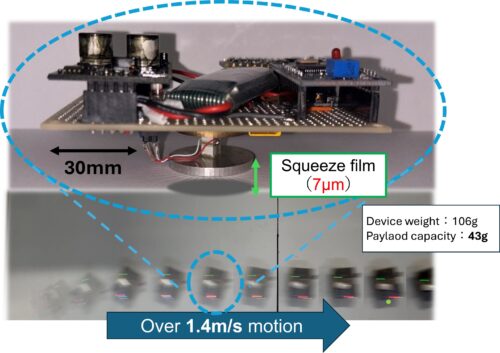
Researchers at Yokohama National University have developed an untethered levitation device capable of moving in any direction. The findings are detailed in Advanced Intelligent Systems. This compact, cable-free platform supports high-speed, multidirectional movement for precision handling, clean-room work, and other fields where contact-free transport is needed.
Its frictionless design enables ultrafast and agile motion, making it highly suitable for contactless transport in machine assembly, as well as biomedical and chemical applications. The device’s future development will focus on improving levitation efficiency, boosting stability under load, and enabling operation on irregular surfaces. Now, researchers are planning to combine multiple units with propulsion systems to build robots out of the device for contactless deliveries.
Researchers have confirmed that the experimental findings are in line with the theoretical predictions. In trials, the device maintained frictionless motion at speeds exceeding 3 m/s along an inclined plane. At 10° inclination, it travelled freely when levitation was active, but when the levitation system was switched off, gravitational force prevented any movement, providing clear evidence of the levitation mechanism’s effectiveness.
Under load, the system continued to levitate and move without resistance when the total load was kept at or below 150 g. That means it could carry an additional 43 g beyond its own weight. Any load exceeding this limit halted both levitation and movement.
The researchers have used acoustic levitation, which suspends objects using sound waves. It had its challenge: the need for cables. However, it was resolved by researchers through an innovative design that combines acoustic levitation with a piezoelectric actuator.
This actuator, which converts electrical energy into mechanical force, was used to generate a squeeze film, a thin layer of fluid compressed between two surfaces, enabling omnidirectional and frictionless motion without any physical tethers.
“While acoustic levitation removes floor friction, conventional systems rely on cables that disturb positioning. We solved this by developing an untethered levitation device with a wireless drive circuit, enabling stable levitation height and high-speed, flexible transport,” said Ohmi Fuchiwaki, Associate Professor and Researcher at Yokohama National University.