




What if satellites could independently choose the most valuable data to solve problems on Earth? SkyServe, based in Bengaluru, is bringing that idea to life.
Vinay Simha, Vishesh Vatsal, and Adithya K started their journey together while working at an aerospace company called Team Indus, building India’s first private lunar rover. There, they focused on creating a spacecraft for lunar landings and a lunar rover that would compete under the Google Lunar X Prize.
After leaving the company, the three co-founded a startup named SkyServe. They started seeking ways to apply their expertise with greater commercial impact. Since deep space missions often take many years to show business value, they turned their attention to Earth observation. As AI and deep learning began to emerge in the space sector, they identified a promising opportunity to innovate.

The startup claims to design the technology for smarter satellites. The smart satellites could, for instance, recognise in real time which parts of the Earth were covered in clouds and avoid sending that data. Instead, they can focus only on clear areas, making much better use of the available communication bandwidth. Beyond that, these satellites could perform specific tasks directly in orbit. For instance, while flying over Australia, they could detect wildfires, and minutes later, while passing over India, they could identify flooding in a city like Chennai. All of this processing happens onboard the satellite, and the results can be delivered to users in minutes, not days.
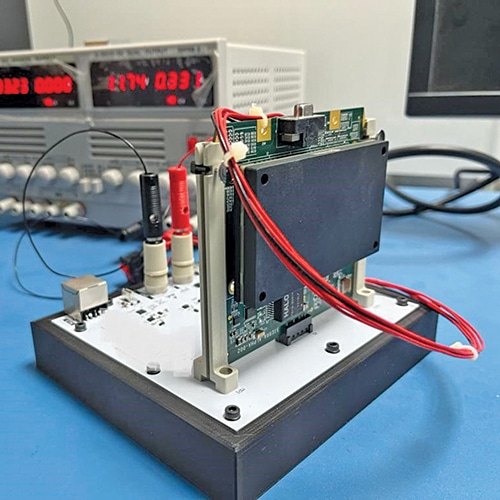
Discussing the electronics behind the innovation, Vishesh explains, “Electronics play a key role in this setup, particularly the onboard computing systems. These systems are hosted payloads on satellites and include hardware, data and power interfaces connected to the satellite’s primary computer. To make this work, we have developed a reliable and adaptive interface that allows their computing systems to communicate with the rest of the satellite.”
Check the full conversation with Vishesh Vatsal from SkyServe.
Beyond images, satellites also generate other forms of data, such as time-series data or health monitoring information. The startup also applies anomaly detection models to this data. The types of models they work with include computer vision, deep learning models, change detection models, and time-series AI. While large language models may also be part of the future, they are not the main focus. The emphasis remains on building models that deliver actionable insights from space, in real time.


Regarding target users, Vishesh says, “Our target customers are broadly two groups. One group includes government users focused on strategic needs and disaster response. The other includes commercial users in sectors like maritime, insurance, and emergency monitoring. Both need faster insights to respond to time-critical events, and that is where edge computing in space becomes critical.”
However, designing AI models for space presents unique challenges. Unlike ground-based or automotive systems, where power and memory are more abundant, satellites operate under tight resource constraints. Models running on edge computers in space must use minimal memory and consume as little power as possible. This makes it necessary to optimise each algorithm carefully before deployment.
“We address this by using model compression techniques. These methods reduce the size and computational load of AI models, allowing them to run within the strict limits of satellite hardware. Every bit of power, memory and storage must be accounted for, and the models must be built to perform reliably in such conditions. This balance of efficiency and performance is critical to making edge AI in space both practical and scalable,” says Vishesh.
Commercialising space technology requires patience. As Vishesh explains, “In the initial years, we focused on building technical readiness using investment capital. Now, with some of our work being commercialised, we have started generating revenue. We are not yet profitable, but as more satellite operators adopt our infrastructure, we believe we’re not far from it.”
Looking ahead, the team believes that more collaboration across the Indian space tech ecosystem will be crucial. They say the ecosystem is still small and would benefit from a stronger collaborative environment. This includes greater government support and funding for emerging technologies. The startup is already participating in large-scale contract programmes and is actively engaging with policy initiatives.


