A new reflective gold layer allows ultrathin solar cells to absorb more light, improving the efficiency without increasing the material use.
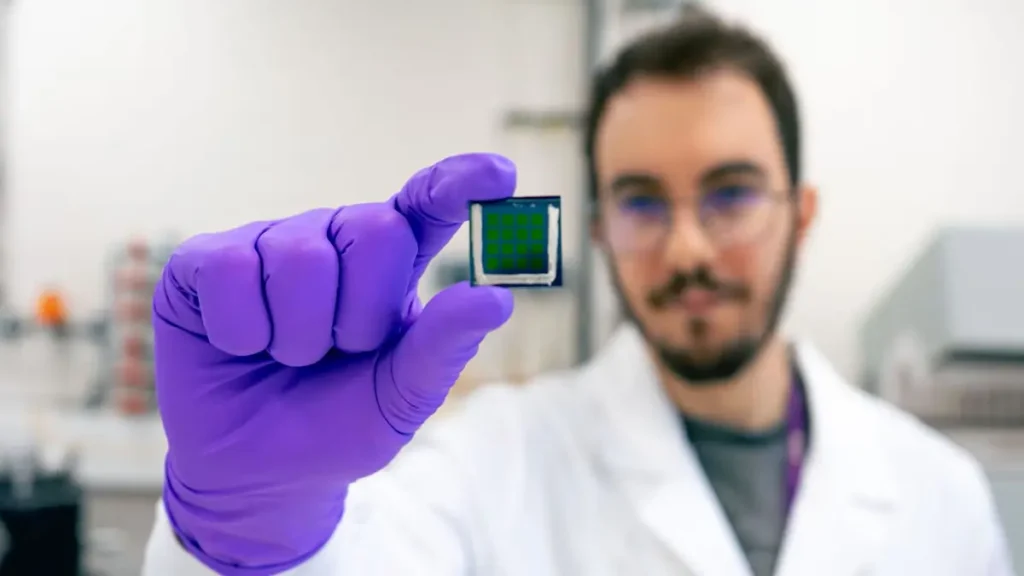
Coating the solar cells with gold-based nano material increases the efficiency of, while keeping them light weight and flexible. The nano structured gold layer acts as a mirror, coated on the back of the ultrathin solar cells. This design increases the amount of sunlight absorbed without adding significant weight to the device.
Ultrathin solar cells are made of light and thin material. Because of their thinness, they can’t absorb light as much and the efficiency drops. To overcome this, the research team coats a patterned layer of gold and covers it with aluminium oxide. This coating reflects unabsorbed light back into the cell, allowing it to be reused for power generation.
The aluminium oxide layer also reduces energy loss by preventing electrons from escaping through the back surface, a process known as interface passivation. This combination helps the solar cell maintain higher efficiency even at very thin levels.
The researchers from the International Iberian Nanotechnology Laboratory in collaboration with Uppsala University in Sweden uses a process called nanoimprint lithography to form the gold pattern. The method stamps nanoscale features directly onto the material, making it simpler and faster for large-scale production than traditional nanofabrication methods.
They tested the coating on ACIGS ((Ag,Cu)(In,Ga)Se₂) thin-film solar cells, finding an efficiency improvement of about 1.5 percent due to better light trapping. The best performance was achieved when the cells were processed at 450°C, which prevented gold atoms from diffusing into the layers and affecting output.
The approach can be applied to flexible materials like plastic, enabling the use of thin and light solar panels on vehicles, building surfaces, and portable systems. The study shows how nanoscale coatings can make solar technologies more efficient and suitable for varied applications.