

What if your health tracker never needed charging, screens, or apps, yet still nudged you when goals were met? A small wearable is making it work.
Being deeply immersed in tech can feel like whiplash. The pendulum of progress keeps swinging. One moment, microservices dominate. When complexity grows, monolithic applications take over, until the same old problems bring microservices back into favor.
On the hardware side, consolidation has taken over. Phones now come with laptop-grade processors, ultra-high-res cameras, loads of sensors, and nearly everything else. Smartwatches, refrigerators, and other gadgets follow the same trend. But packing in everything often sacrifices the advantages of purpose-built devices. For users who just want a simple, reliable solution, these all-in-one devices can be overwhelming and inefficient.
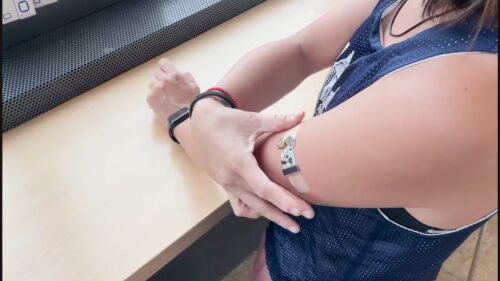
Researchers at Carnegie Mellon University and UCLA argue that wearables could benefit from slimming down. To explore this, they created Hapt-Aids, bandage-like, self-powered devices built solely for human activity monitoring. Unlike smartwatches, Hapt-Aids do not need charging, screens, Bluetooth, or microcontrollers. They rely entirely on analog circuits to harvest, interpret, and use energy from the wearer’s movements or environment. Every device passively gathers energy from walking, exercising, or even lying in the sun, and uses that energy both to measure activity and to signal the user when a threshold is reached.
This works through a small energy harvester, like a piezoelectric element or solar cell, which captures energy from motion or light. The energy is stored in a tiny supercapacitor. As the capacitor fills, it represents how much activity the user has done, steps walked, time spent in sunlight, and so on. When it reaches a set level, an analog circuit releases the energy in a short vibration buzz. This haptic feedback tells the wearer they have reached their goal.
Researchers tested multiple Hapt-Aid prototypes powered by motion, heat, or light. Each generated enough energy to produce a noticeable vibration, proving the concept works in real-world scenarios.
Hapt-Aids show that sometimes less really is more. By reducing cost, size, and maintenance, they could make health and activity monitoring as simple as putting on a Band-Aid.