






A Wireless Energy Monitoring System that tracks the energy consumption of the appliances, processes data, and enables remote monitoring and control of home appliances through Wi-Fi connectivity.
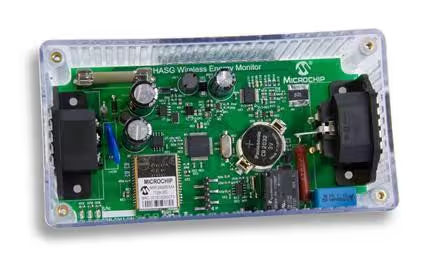
Smart home products have one persistent engineering challenge: how to keep track of energy use accurately while keeping the design compact, power-efficient, and affordable. Measuring voltage and current, storing the data, and sending it wirelessly to the cloud often requires multiple chips and weeks of firmware tuning.
A reference design from Microchip Technology features an energy-monitoring system with wireless communication, simplifying the design process. This Wireless Energy Monitor enables real-time consumption data collection and remote on/off control. The board brings together measurement accuracy, Wi-Fi connectivity, and low-power operation in a small, cost-effective package.
The design measures and records the energy consumption of a connected appliance, while also allowing users to control the load remotely.
At its core is a 16-bit microcontroller that coordinates the entire system. Paired with the MCP3901 energy monitor sensor, the analogue front end (AFE) captures both voltage and current with high precision. The AFE’s dual 16/24-bit ADCs deliver reliable RMS voltage, current, and active power readings, which are essential building blocks for accurate energy metering.
Wireless communication is handled by the MRF24WB0MA Wi-Fi module. For timekeeping and local data storage, the system includes an MCP79410 real-time clock with battery backup and a SST25VF032B 32-Mbit serial flash memory chip.
The design can be adapted for smart plugs, connected appliances, building automation systems, energy-aware consumer electronics, or IoT gateways that aggregate multiple loads. Its flexibility makes it suitable for both residential and small commercial energy-management platforms.
Power management is handled through linear and switching regulators, which deliver stable 5 V and 3.3 V rails while keeping standby draw extremely low. The system’s efficient design ensures the monitor itself doesn’t add significantly to total power use — an important point for energy-conscious appliances.
Engineers receive a complete design package, including schematics, BOM, firmware, and PCB Microchip Technology has tested this reference design. It comes with a bill of materials (BOM), schematics, assembly drawing, printed circuit board (PCB) layout, and more. The company’s website has additional data about the reference design. To read more about this reference design, click here

