The heating problem is common with data centers. Can this cooling method help reduce heating issues without fans or pumps? Find out!
We rely more on AI, cloud computing and electronics, and that means we create more heat than current cooling systems can handle. Cooling uses up to 40% of a data center’s electricity. If this continues, global energy demand for cooling could more than double by 2030. We need a better way to manage heat before it takes more energy and cost.
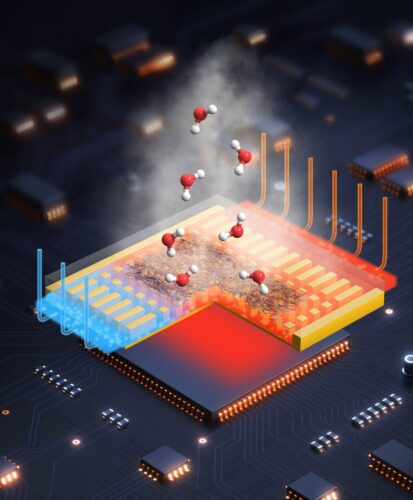
A team at the University of California San Diego has built a cooling system that works through evaporation instead of using fans, pumps or heat sinks. It works like how sweat cools our skin but for CPUs, GPUs and other electronics.
Here is how it works. A fiber membrane sits above microchannels that carry liquid. Through capillary action, the membrane pulls the liquid upward. As the liquid evaporates, it removes heat from the surface below without using extra energy.
Evaporation can remove more heat using less energy than air or liquid cooling, but using it for high-power electronics has been hard. Earlier porous membranes clogged or caused boiling. The UC San Diego team fixed this by creating fiber membranes with pores of the right size. They do not clog or boil, and this keeps cooling steady.
In tests, the system removed heat above 800 watts per square centimeter and stayed stable for hours. These fiber membranes were first made for filtration, but after reinforcing, they worked for cooling too. This shows how one material can solve a problem in another area.
The system has not reached its full limit. Researchers are working to improve the membrane and build cold plate prototypes for CPUs and GPUs. They are also thinking about starting a company to bring the technology to market. If the team succeeds, energy use in data centers and electronic systems could be reduced, making computing less costly in terms of energy.