Quantum rod LEDs are more efficient. Problems with light loss and leakage are solved. See how this could change phone and TV screens.
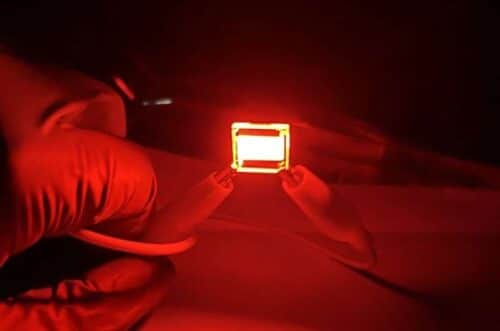
Smartphone and television users could soon see brighter and more vivid visuals thanks to a new breakthrough in red quantum rod light-emitting diodes (QR-LEDs). Researchers at the School of Engineering at The Hong Kong University of Science and Technology (HKUST) have achieved record-high efficiency in these devices, potentially transforming display and lighting technologies.
Traditional LEDs have been used in electronics for decades, but their performance is limited by color purity and brightness. Quantum dot LEDs (QD-LEDs) improved these aspects, yet they still face a ceiling in external quantum efficiency (EQE) due to limited outcoupling efficiency. QR-LEDs, built from elongated nanocrystals called quantum rods, can direct light emission more effectively and improve outcoupling, offering a route to higher efficiency.
However, QR-LEDs have two major challenges. First, they can exhibit low photoluminescence quantum yield after absorbing photons. Second, irregular thin-film formation leads to significant leakage current, reducing device performance. Previous research often overlooked the impact of this leakage current.
The team addressed these issues by refining the synthesis of quantum rods to achieve uniform size, controlled shape, and photoluminescence quantum yields up to 92% for both green and red rods. They also developed an equivalent circuit model to understand how leakage currents in conventional QR-LED structures affect light output. Using these insights, the device structure was redesigned to suppress leakage while maintaining balanced carrier injection, boosting overall efficiency.
The results set new benchmarks. Red QR-LEDs achieved a peak EQE of 31% and brightness of 110,000 cd m⁻², while green “dot-in-rod” QR-LEDs reached a peak EQE of 20.2% and ultra-high luminance of 250,000 cd m⁻². These improvements show that optimizing device structure and emissive layer quality can overcome the inherent issues caused by the elongated shape of quantum rods, such as pinhole-induced leakage.
This work highlights the fundamental advantages of QR-LEDs over QD-LEDs and provides guidance for future development of anisotropic nanocrystals. It opens the door to more efficient, high-brightness, and commercially viable next-generation display and lighting technologies.