





Researchers optimise ultraviolet avalanche photodiodes by fine-tuning electric field and absorption layers, increasing quantum efficiency for detecting photons accurately.
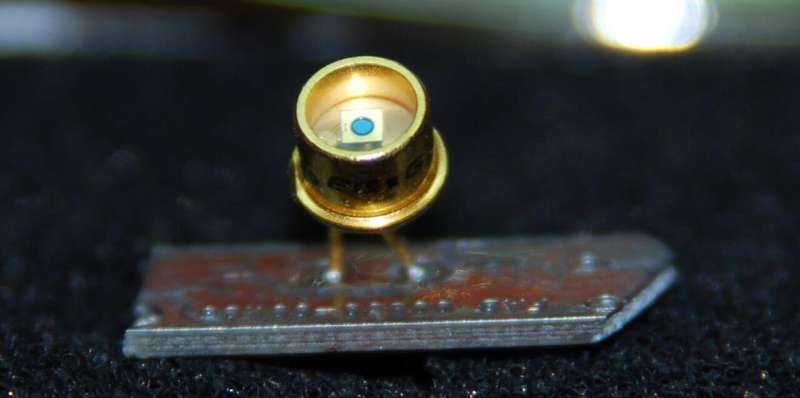
Most photodiodes cannot absorb enough light to detect photons in the ultraviolet wavelength range. When fewer photons are absorbed, the signal becomes weak, reducing the accuracy of detection.
This limits the use of such detectors in areas such as UV-based monitoring, flame detection, and solar-blind imaging, where very small amounts of light need to be measured with precision.
To solve this problem, researchers at the DEVCOM Army Research Laboratory in the US are improving avalanche photodiodes (APDs) made from 4H-silicon carbide (4H-SiC). These devices work by multiplying the electrical signal that appears when a single photon hits the material and releases charged particles.
When the device is operated at a voltage above a certain threshold, known as the breakdown voltage, these charges multiply rapidly and create a detectable pulse. For good single-photon detection, the APD must absorb most of the incoming photons and keep a strong internal electric field.
In the ultraviolet range, photons are harder to absorb, so the absorbing layer of the APD must be made thicker. However, making it thicker alters the electric field and impacts performance. Traditional PIN-type APDs cannot handle this well.
To overcome this, researchers have utilised computer models to design a new structure known as separate-absorption charge-multiplication (SACM). This design separates the light-absorbing layer from the charge-multiplying layer, allowing better control over both absorption and electric field strength.
The study compares two versions of this design: non-reach-through (NRT) and reach-through (RT). The models indicate that the NRT type can achieve a photon absorption efficiency, or quantum efficiency (QE), of approximately 32%.
In comparison, the RT type can reach up to 71% at a wavelength of 340 nanometers. Both types can still maintain the strong field needed for single-photon detection.
