




A new memristor integration could revolutionize AI hardware, enabling ultra-dense, energy-efficient chips that mimic the human brain’s architecture—overcoming long-standing barriers in scale and performance.
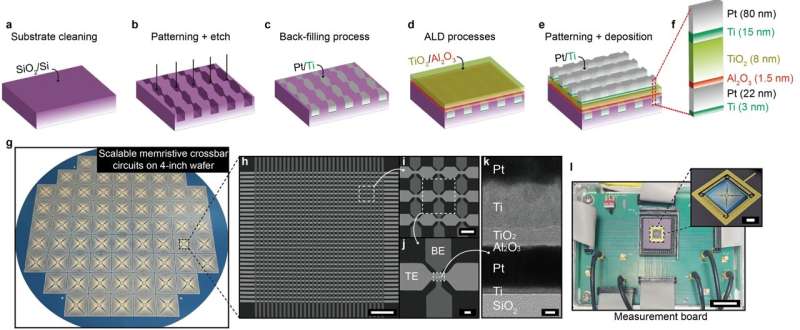
Researchers at the Daegu Gyeongbuk Institute of Science and Technology (DGIST) have achieved a significant milestone in semiconductor technology by developing a wafer-scale memristor integration process, potentially paving the way for AI chips that mimic the human brain.
The team, led by Professor Sanghyeon Choi from DGIST’s Department of Electrical Engineering and Computer Science, published their findings in Nature Communications, showcasing a method that overcomes long-standing barriers in memristor production. Memristors, which can store information by remembering the current that flows through them, are seen as a promising alternative to conventional semiconductors for next-generation AI systems. Unlike standard chips that separate memory and computation, memristors can perform both simultaneously, enabling higher efficiency in a smaller footprint.
While memristors have been demonstrated in small-scale experiments, scaling up has been difficult due to process complexity, low yield, voltage drops, and current leakage. By collaborating with Dr. Dmitri Strukov’s group at UC Santa Barbara, Choi’s team implemented a co-design strategy integrating materials, device architecture, circuits, and algorithms. This approach allowed them to fabricate a memristor crossbar circuit on a 4-inch wafer with a remarkable 95% yield, without relying on complex manufacturing steps.
The study also demonstrated a 3D vertical stacking structure, which could allow memristor-based circuits to expand into large-scale AI computing systems. When applied to spiking neural networks, the technology showed both high efficiency and stable performance, highlighting its potential for practical AI workloads.
Human brains, with roughly 100 billion neurons and 100 trillion synapses, manage massive amounts of data with extreme energy efficiency. Current AI semiconductors fall short in density and power efficiency. Memristors, particularly in a crossbar configuration, can store dozens of times more information in the same area than traditional SRAM, making them ideal candidates for brain-inspired AI chips.
Professor Choi emphasized that this research marks a significant advance in overcoming previous integration limitations, suggesting that the work could form the foundation of next-generation semiconductor platforms capable of supporting highly efficient, large-scale AI computation.

