





By bridging ethernet directly to local digital interfaces, the latest endpoints remove code from the equation and streamline everything from lighting modules to distributed audio systems.
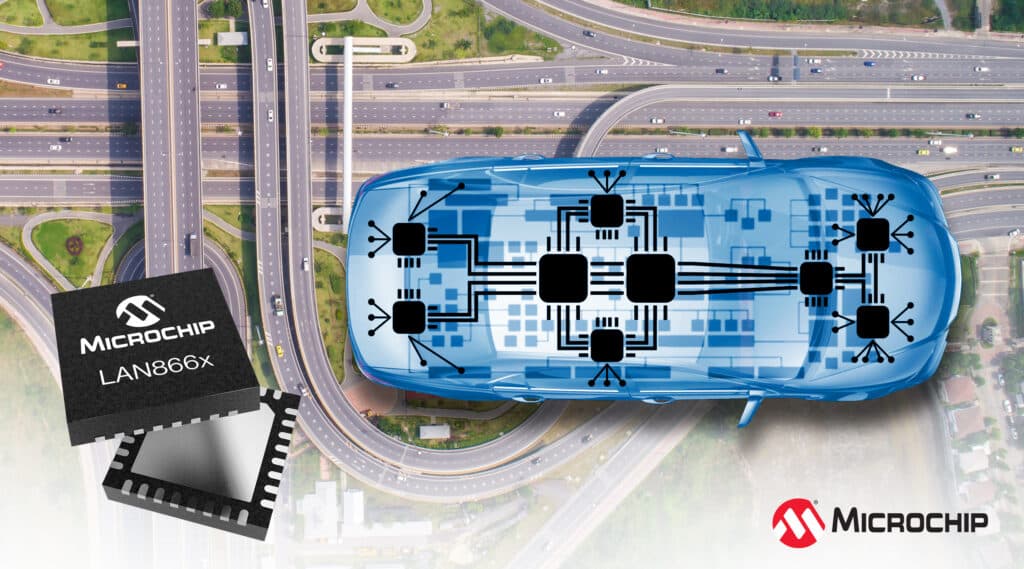
Automakers racing toward zonal vehicle architectures just got a new building block that could simplify one of the industry’s messiest problems: connecting dozens of edge devices without turning every sensor and actuator into a miniature software project. Microchip has introduced a new family of 10BASE-T1S endpoint devicesLAN866xthat act as software-free Ethernet bridges for remote nodes, aiming to cut both cabling and code from next-generation automotive networks.
The key features are:
- Architecture: 10BASE-T1S single-pair Ethernet with Remote Control Protocol (RCP) for node-control/management.
- Automotive qualification: AEC-Q100 Grade 1.
- Temperature class: TC14/TC10 (for this family).
- Link speed: 10 Mbps (over single-pair Ethernet 10BASE-T1S).
- Intended topology: multidrop single-pair Ethernet bus (supporting zonal architectures).
At the core is a simple idea: shift intelligence toward the vehicle’s central compute zones and strip it away from the periphery. Instead of embedding microcontrollers and custom firmware into every lighting module, microphone array or actuator, the new endpoints translate Ethernet packets directly into basic digital interfaces. Because they rely on the Remote Control Protocol (RCP), the devices let a central controller manage configuration, data streams and diagnostics without needing silicon or software at each node.
That approach matters as zonal architecture scales. Today’s vehicles might pack 70+ ECUs and kilometres of wiring; tomorrow’s software-defined cars want to collapse that into fewer domain controllers connected to long chains of smart or simple edge devices. Using a 10BASE-T1S multidrop topology, the LAN866x parts fit right into that shift, supporting an “all-Ethernet” vision that reduces the bulk of wiring looms and the hidden integration cost of per-node software.
The immediate impact shows up in everyday subsystems. Lighting modules can receive Ethernet data and drive LEDs directly. Audio peripherals/microphones and distributed speakers can feed data through the same lightweight topology. Small actuators and sensors gain plug-and-play connectivity without the overhead of a full MCU. In short, the endpoints give carmakers a way to simplify the “long tail” of devices that previously needed dedicated hardware, firmware and testing.
The launch slots into the company’s broader Single Pair Ethernet portfolio, which spans transceivers, bridges, switches and development tools for 10BASE-T1S through 1000BASE-T1. With the industry pivoting toward scalable electrical architectures and centralized compute, the LAN866x endpoints signal how aggressively Ethernet continues to push toward the vehicle’s physical edge one simplified node at a time.
For more information, click here.

