Years of custom field work are shaping a product line with its own cloud, its own hardware, and a market that is now beginning to recognise its value.
Ionicks did not begin as a startup with a pitch deck or a classroom idea. It began as a service shop handling custom automation jobs for clients. In those early years, everything inside the panels ran on programmable logic controllers (PLCs). While delivering those jobs, B. Thangathurai continued searching for better methods to build control systems. That search gradually pushed the work from PLCs to embedded systems, and once that shift occurred, the path to IoT opened.
Instead of using bulky controllers, the team moved to MCUs. Instead of renting space on AWS or Google, they built their own cloud using open source tools. Everything from the device to the network to the server runs on systems under their control. Nothing sits in a black box.
The name Ionicks originates from the word ‘ion,’ a charged particle that triggers reactions. For the team, that ion represents how a small signal can initiate a much larger process, similar to the devices they aim to place inside machines and networks. Today, they offer their own products in the market, providing customers with comprehensive electrical solutions.
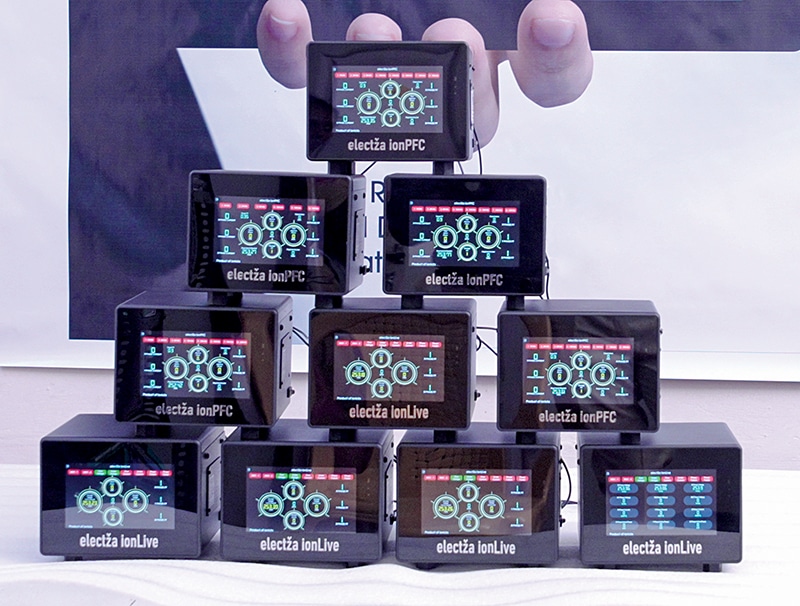
When asked about their innovation, Thangathurai explains, “For over-voltage protection, there is a separate device. For power-factor correction, there is another device. For maximum demand control, there is another device. For remote switching, people typically purchase a smart switch as a standalone unit. We have built a single product that performs all of this in a single unit. It has a built-in RTC. Most market switches do not come with an RTC. Because it has its own RTC, even without Wi-Fi or internet the schedule runs from the MCU itself.”

They also work with a model called an intelligent field device (IFD). “The IFD itself is a model from outside, but we manufacture the gate-phase part for it. We have our own embedded team. Design-to-finish hardware is done in-house. PCB design and software are also done in-house. Only PCB fabrication is outsourced,” says Thangathurai.
For battery management, they do not have backup inside the device yet. In industrial settings, the inverter supply is given externally to feed the equipment. In the near future, they plan to add built-in battery backup. For data, they have already achieved real-time updates. The device sends data every 500 milliseconds.
The main challenge they face now is not technology but market entry. As a new company, the difficulty lies in customer acquisition. It is mainly a marketing challenge and they are working through it. On discussing the revenue generated, Thangathurai discloses, “The product line was released only one year ago. To date, approximately 100 units have been sold. We know this is not enough and we are now working to scale and reach good volume.”
A new line has also started under the name Veoma Track. Veoma means wind. “Under this line we are introducing RFID technology for tracking. One RFID model is for warehouse management, and another is for jewellery shops. These are our own products and both are currently in the pilot stage,” adds Thangathurai.
For future growth, the startup plans to expand primarily through marketing partnerships, not heavy internal hiring. They are looking for dealers, distributors, and committed partners who can take the products to the market.